
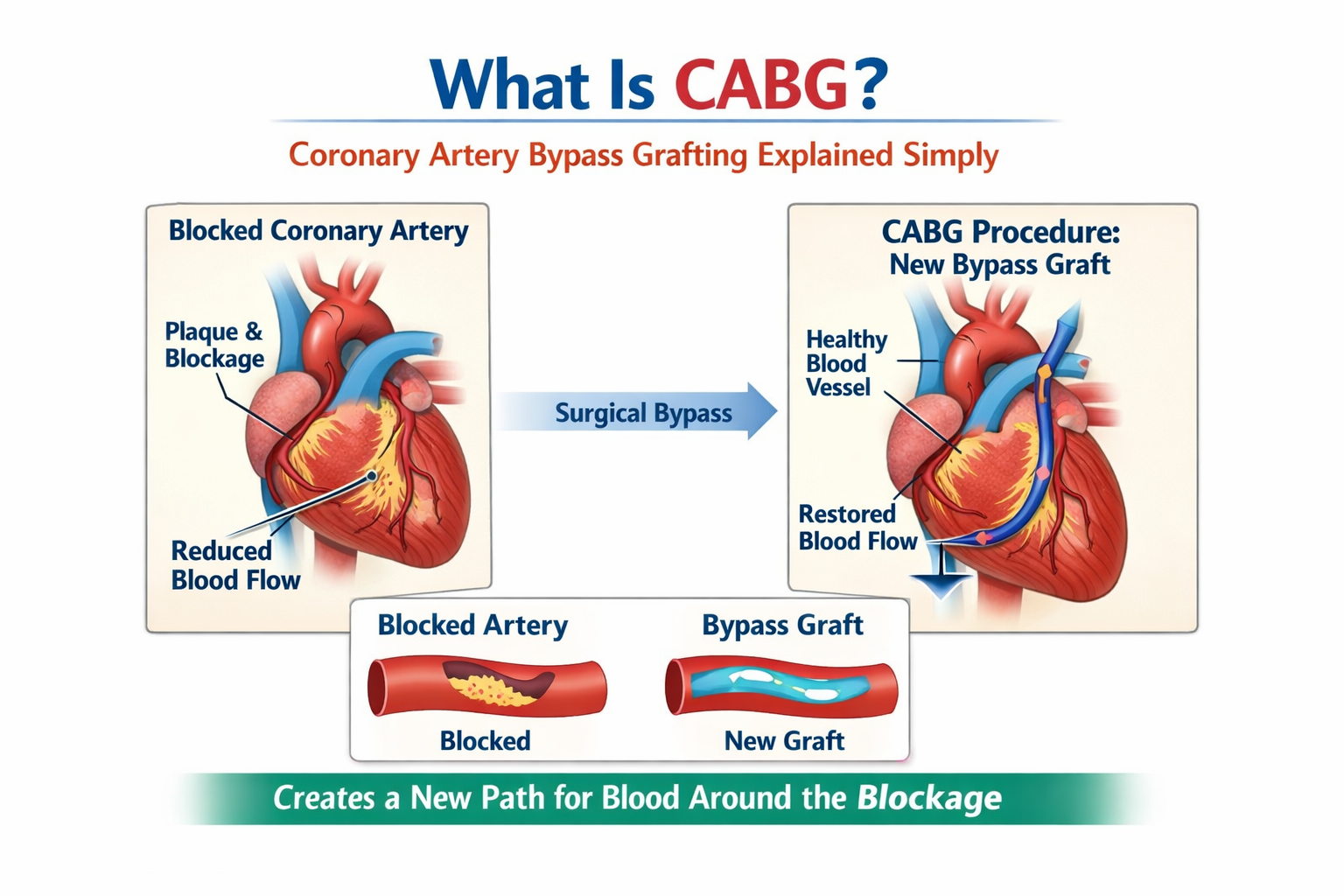
CABG — pronounced “cabbage” — stands for Coronary Artery Bypass Grafting, and it is the most commonly performed open-heart surgery in the world. If your cardiologist has mentioned CABG after your angiography, this article explains exactly what it means, how it differs from stenting, and what to expect at every stage.
Dr. Ved Prakash, Director of CTVS at Yatharth Super Speciality Hospitals, Greater Noida, has performed CABG across Medanta, Narayana, and Sarvodaya with 8+ years of experience in coronary bypass surgery.
What Is CABG — The Simple Explanation
CABG is a surgery that bypasses a blocked coronary artery using a healthy blood vessel taken from elsewhere in your body. The blocked section of the artery is not removed or opened — instead, a new passage is created around it so blood can reach the heart muscle that was being deprived.
Your coronary arteries sit on the surface of your heart and supply it with oxygen-rich blood. When plaque builds up inside them over years, they narrow. When they narrow enough to restrict blood flow significantly — or block it completely — the heart muscle is starved. This causes angina (chest pain), heart attacks, and eventually heart failure.
CABG restores that blood flow permanently and reliably — which is why it remains the gold standard treatment for severe multi-vessel coronary artery disease.
CABG vs Angioplasty — What Is the Difference?
| Feature | CABG (Bypass Surgery) | Angioplasty (Stenting) |
| How it works | New graft vessel bypasses the blockage | Balloon opens the artery; stent holds it open |
| Incision needed? | Yes — chest incision | No — catheter through groin or wrist |
| Recovery time | 6–12 weeks | 2–5 days |
| Best for | Multiple blockages, diabetes, left main disease | Single or simple blockages |
| Durability | LIMA graft lasts 15–20+ years | Stents may re-block in 5–10 years |
| Preferred in diabetes? | Yes — strongly preferred | Higher re-blockage rate in diabetics |
The choice between CABG and angioplasty is made based on your angiogram, your overall health, and whether you have diabetes. It is not a one-size-fits-all decision. For more detail on how this choice is made, read our full guide on what is bypass surgery.
What Vessels Are Used as CABG Grafts?
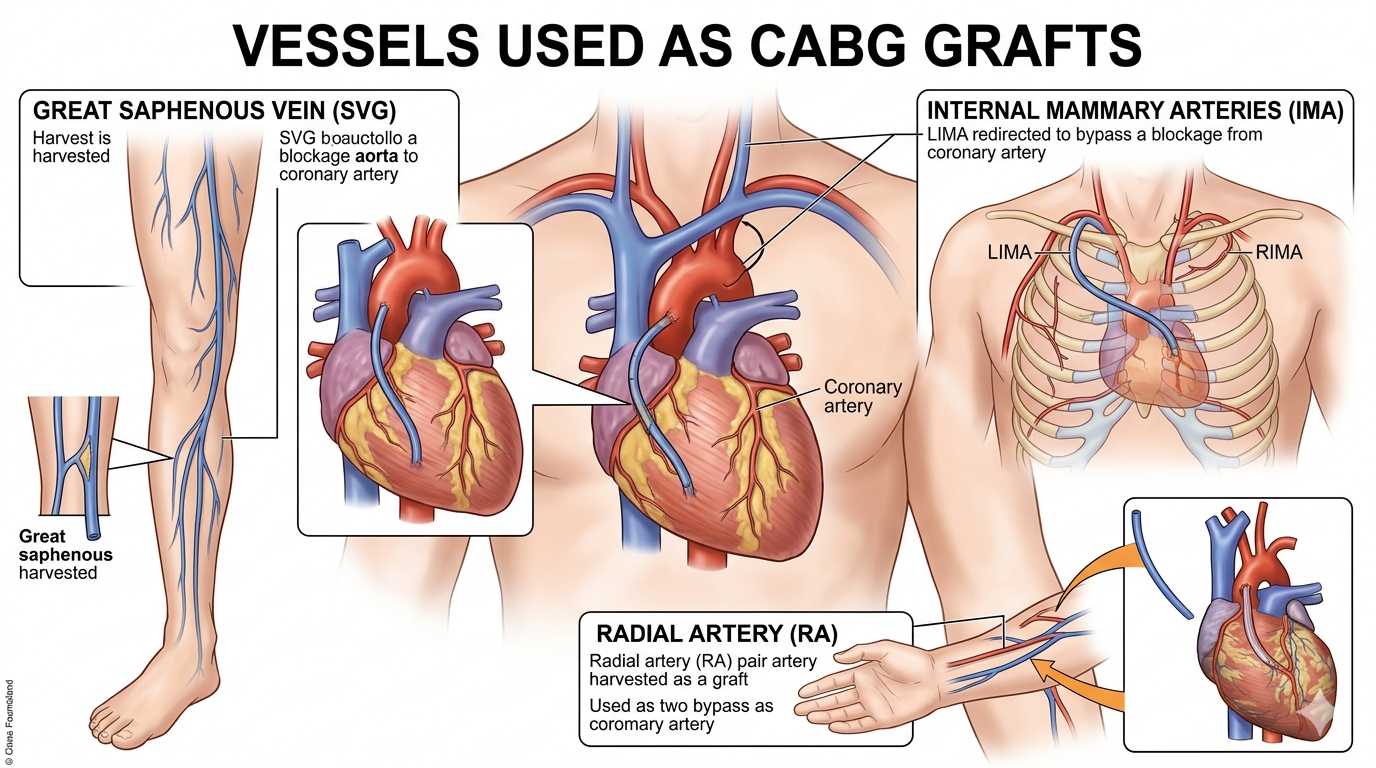
The graft vessel is the new “bypass road.” Three vessels are most commonly used:
- Left Internal Mammary Artery (LIMA) — taken from the inner chest wall. This is the best graft available. It remains open in over 90% of patients at 10 years and is used in virtually every CABG operation. It connects naturally to the most important coronary artery (LAD).
- Saphenous Vein — from the inner leg. Commonly used as the second or third graft. Lasts 10–15 years on average. Leg usually heals within 2 weeks with no functional limitation.
- Radial Artery — from the forearm. An excellent arterial graft with durability close to the LIMA. Used when total arterial revascularisation is planned.
Using two arterial grafts (LIMA + radial artery) — called bilateral arterial grafting — gives the best long-term results and is increasingly preferred for younger patients.
On-Pump vs Off-Pump CABG — Which Is Better?
This is one of the most common questions patients ask before surgery.
- On-pump CABG: A heart-lung machine takes over while the heart is stopped. The surgeon operates on a still, bloodless field — which allows the most precise stitching. Standard approach for complex cases.
- Off-pump CABG (beating heart surgery): The bypass grafts are attached while the heart continues to beat. No heart-lung machine is used. Reduces the risk of kidney problems in patients with pre-existing kidney disease.
The choice is made by Dr. Ved Prakash based on your specific anatomy, heart function, and comorbidities. Both techniques deliver excellent outcomes in experienced hands.
What Does CABG Surgery Involve — Step by Step?
- General anaesthesia — you are fully asleep throughout
- Chest incision — the breastbone (sternum) is divided to access the heart
- Graft harvesting — the LIMA and/or vein graft is prepared
- Bypass grafts attached — one end to the aorta, the other to the coronary artery beyond the blockage
- Chest closed — sternum is wired back together; skin closed with sutures
- Total operative time: 3–5 hours
What Happens After CABG Surgery?
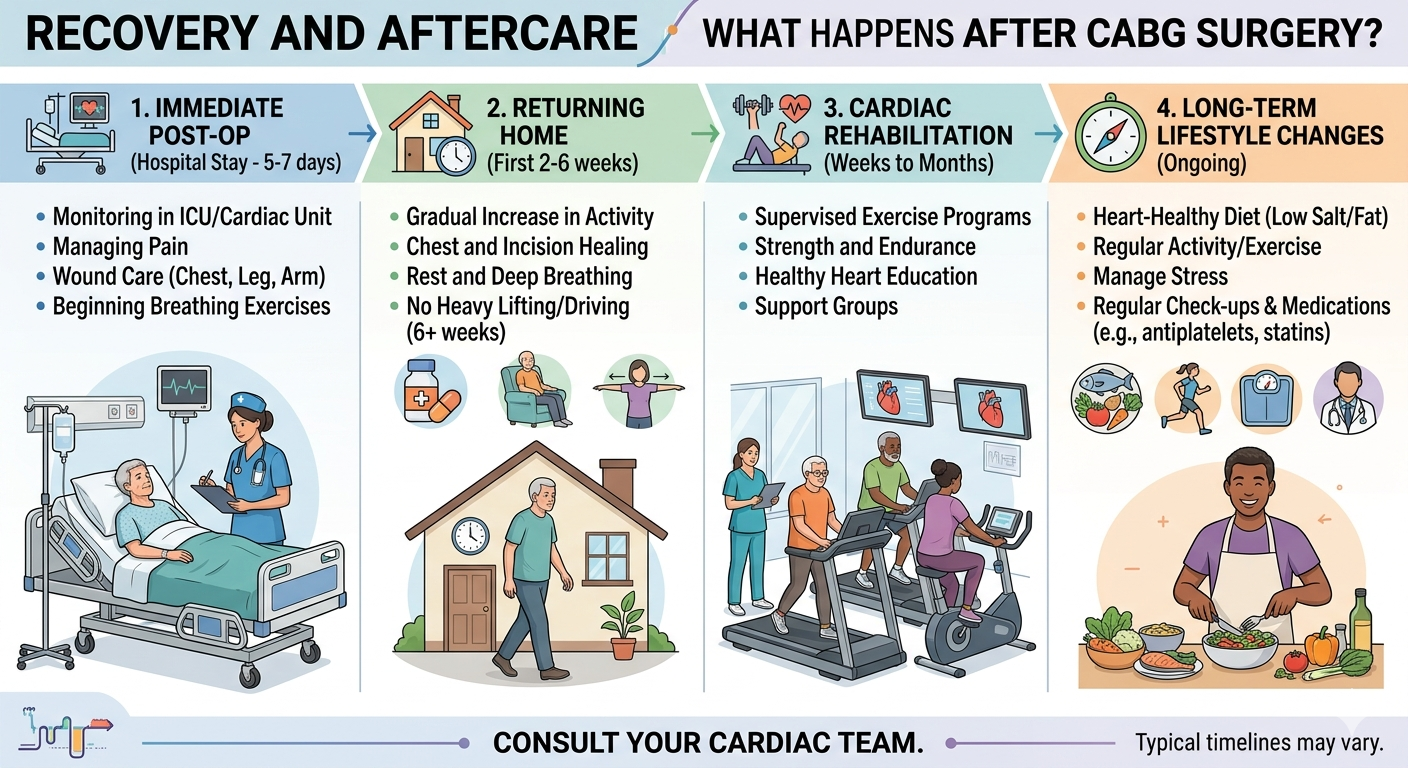
- Cardiac ICU: 24–48 hours for close monitoring and breathing tube removal
- Ward stay: 5–7 days — walking, eating, and recovering
- Home discharge: With medications, wound care instructions, and follow-up dates
- Full recovery: 6–12 weeks depending on age and overall health
 Frequently Asked Questions About CABG
What does CABG stand for?
CABG stands for Coronary Artery Bypass Grafting. It is the medical term for bypass surgery — an operation that creates a new route for blood flow around a blocked coronary artery.
Is CABG a major operation?
Yes. CABG is major open-heart surgery requiring general anaesthesia and a hospital stay of 7–10 days. However, it is one of the most studied and standardised operations in cardiac surgery, with consistently high success rates at experienced centres.
How many bypass grafts can be done in one operation?
Between one and five bypasses can be performed in a single CABG operation, depending on how many coronary arteries are blocked. Triple bypass (three grafts) is the most commonly performed.
Is CABG done under local or general anaesthesia?
Always under general anaesthesia. You are completely unconscious for the entire operation and wake up in the cardiac ICU after it is completed.
Does CABG cure heart disease permanently?
CABG restores blood flow reliably and durably — the LIMA graft lasts 15–20+ years in most patients. It does not stop the underlying process of atherosclerosis. Medications, lifestyle changes, and follow-up remain essential after surgery to protect the grafts and the rest of the heart.
Considering CABG? Talk to Dr. Ved Prakash First.
If CABG has been recommended after your angiography, consult Dr. Ved Prakash for bypass surgery in Delhi NCR at Yatharth Super Speciality Hospitals, Greater Noida. Share your angiogram report via WhatsApp for an online pre-consultation before your visit.
Dr. Ved Prakash | Director CTVS — Yatharth Super Speciality Hospitals, Greater Noida
📞 +91-9355255106 |
Book Appointment →