
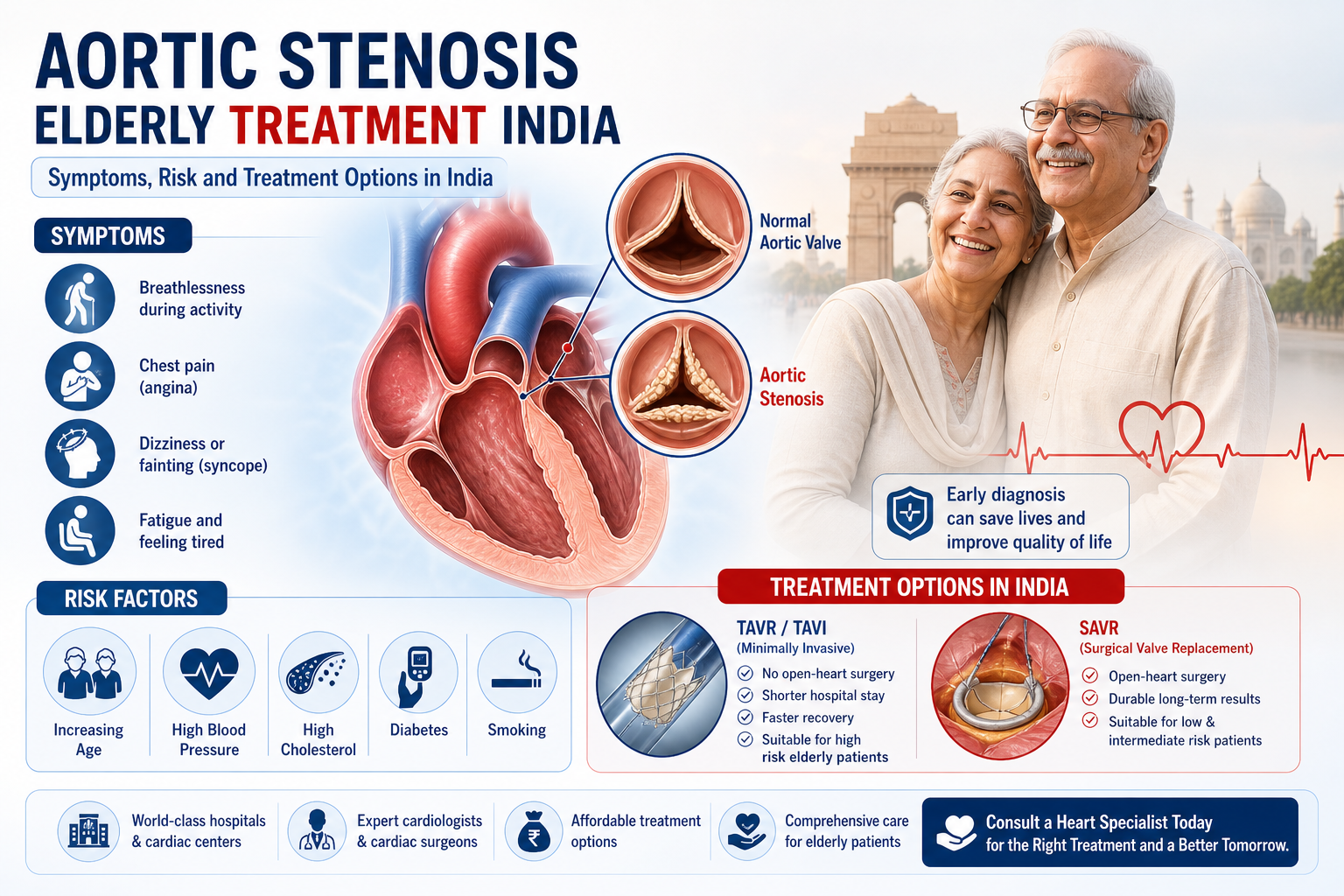
Aortic stenosis is the most common serious heart valve disease in patients over 65 — and it is the condition that most frequently brings elderly patients to a cardiac surgeon’s clinic with the same story: “my parents have been told they need valve surgery but we’ve been told they’re too old or too frail.” That narrative is outdated. The arrival of TAVI — transcatheter aortic valve replacement — has changed the treatment landscape entirely. Dr. Ved Prakash, Director of CTVS at Yatharth Super Speciality Hospitals, Greater Noida, explains aortic stenosis in elderly patients, when it becomes dangerous, and why age alone is no longer a barrier to treatment.
What Is Aortic Stenosis?
The aortic valve sits between the left ventricle (the heart’s main pumping chamber) and the aorta (the main artery to the body). It opens with each heartbeat to let blood out and closes to prevent backflow. In aortic stenosis, the valve leaflets — normally thin and pliable — gradually thicken, stiffen, and calcify over decades. The valve opening progressively narrows until blood cannot flow freely from the heart to the body.
The heart compensates initially by working harder — the left ventricular wall thickens to overcome the resistance. But this compensation has limits. When the valve becomes severely narrowed and the heart can no longer compensate, symptoms appear — and once they do, the clock starts.
Aortic Stenosis Symptoms in Elderly Patients — The Critical Triad
Three symptoms mark the transition from compensated to decompensated aortic stenosis. Each carries a specific prognostic implication:
Breathlessness on Exertion
The earliest and most common symptom. The heart cannot increase its output sufficiently during exercise — blood backs up into the lungs, causing breathlessness. Initially noticed on climbing stairs or walking uphill. As aortic stenosis worsens, the breathlessness occurs with less and less activity — until it is present at rest (pulmonary oedema). In elderly patients, this symptom is frequently attributed to age, obesity, or deconditioning — and the aortic stenosis diagnosis is missed for months or years.
Syncope (Blackouts)
Brief loss of consciousness — often during or immediately after exertion. The narrowed valve cannot allow the increased blood flow the body demands during activity, causing a momentary drop in cerebral perfusion. In the elderly, syncope from aortic stenosis is frequently misdiagnosed as a neurological event or orthostatic hypotension. An echocardiogram should be part of the work-up for every elderly patient with unexplained syncope.
Chest Pain (Angina)
The thickened left ventricle, pumping against the high resistance of the stenotic valve, outgrows its blood supply — producing angina from the heart muscle itself, even in patients without coronary artery disease. Aortic stenosis angina mimics coronary angina exactly — central chest tightness on exertion — but the cause is the valve, not the coronary arteries.
Why Timing Matters — Survival Without Treatment
Once symptoms appear in severe aortic stenosis, the prognosis without treatment is sobering:
| Symptom at Onset | Average Survival Without Treatment |
| Heart failure / breathlessness | 1–2 years |
| Syncope (blackouts) | 2–3 years |
| Angina (chest pain) | 3–5 years |
These figures come from natural history studies conducted before modern treatment was available — but they remain clinically relevant because they illustrate why symptomatic severe aortic stenosis is treated as urgently as triple vessel coronary disease. The mistake many families make is waiting until the elderly patient is “more comfortable” or “stronger” before accepting treatment — during which time the ventricle continues to deteriorate, making eventual surgery more risky, not less.
Treatment Options for Aortic Stenosis in Elderly Patients in India
TAVI — Transcatheter Aortic Valve Implantation
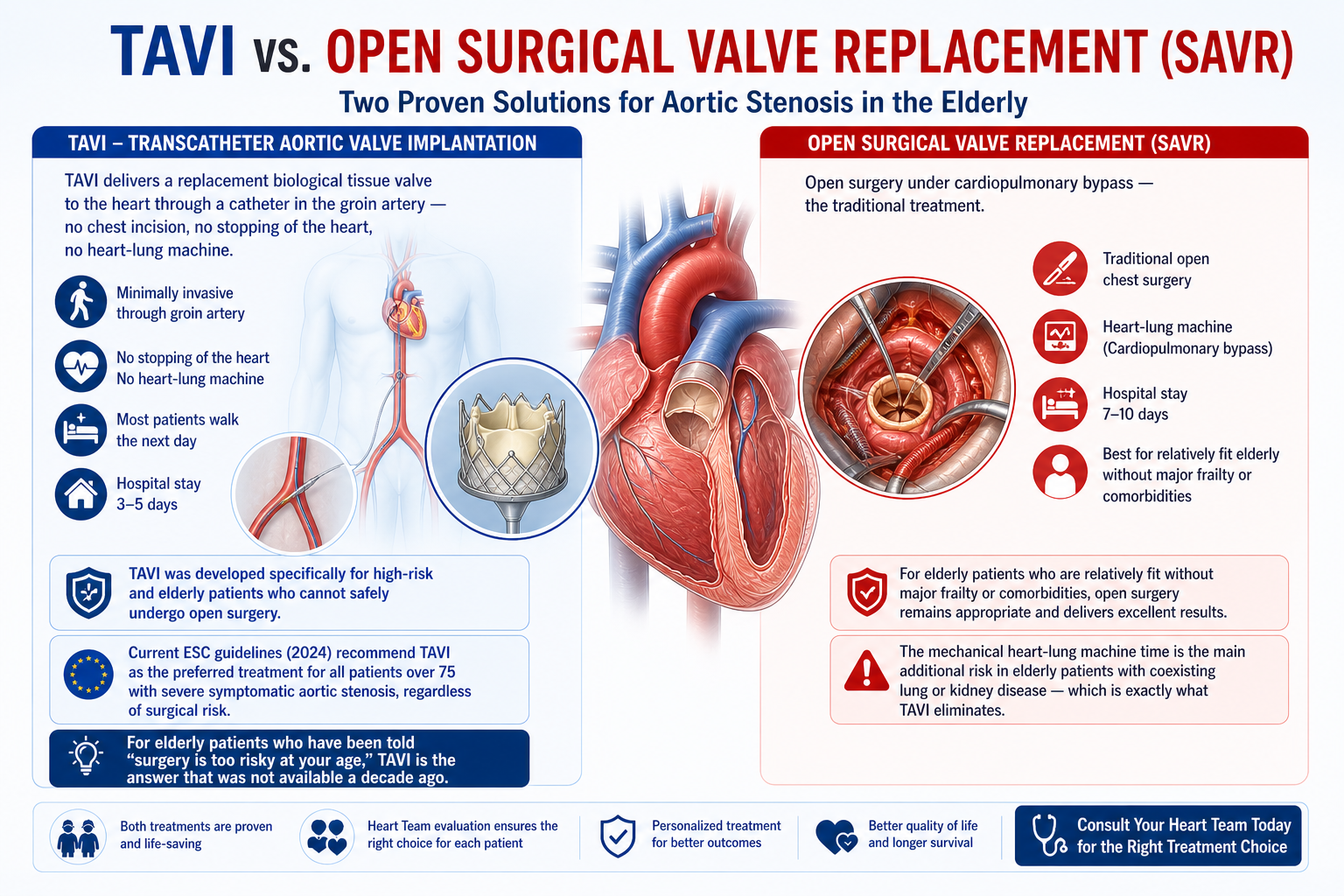
TAVI delivers a replacement biological tissue valve to the heart through a catheter in the groin artery — no chest incision, no stopping of the heart, no heart-lung machine. Most patients walk the next day and go home within 3–5 days. TAVI was developed specifically for high-risk and elderly patients who cannot safely undergo open surgery. Current ESC guidelines (2024) recommend TAVI as the preferred treatment for all patients over 75 with severe symptomatic aortic stenosis, regardless of surgical risk.
For elderly patients who have been told “surgery is too risky at your age,” TAVI is the answer that was not available a decade ago. Read the complete guide on TAVI — transcatheter aortic valve replacement.
Open Surgical Valve Replacement (SAVR)
Open surgery under cardiopulmonary bypass — the traditional treatment. Hospital stay 7–10 days. For elderly patients who are relatively fit without major frailty or comorbidities, open surgery remains appropriate and delivers excellent results. The mechanical heart-lung machine time is the main additional risk in elderly patients with coexisting lung or kidney disease — which is exactly what TAVI eliminates.
Medication Alone — Not a Treatment for the Stenosis
No medication improves survival or slows progression in severe symptomatic aortic stenosis. Medications manage symptoms only — diuretics for breathlessness, rate control for atrial fibrillation. Medical management alone in symptomatic severe aortic stenosis is associated with the survival figures in the table above.
The Most Common Reason Elderly Patients Are Not Treated — And Why It Is Often Wrong
The most common reason elderly patients in India with severe aortic stenosis are not offered treatment is that the family or the non-specialist physician concludes that “they are too old” or “the heart is too weak” for surgery. In many cases, this is incorrect. TAVI specifically exists to treat these patients. An elderly patient who is too frail for open surgery may be a completely appropriate TAVI candidate.
Before accepting a recommendation that an elderly family member with severe aortic stenosis “cannot be treated,” ask specifically whether they have been assessed by a Heart Team — cardiologist plus cardiac surgeon — for TAVI. This is the standard of care and is available at Yatharth Hospital, Greater Noida. Visit the heart valve surgery page or share the patient’s echocardiogram via WhatsApp at +91-9355255106 for a pre-assessment.
Frequently Asked Questions — Aortic Stenosis Elderly Treatment India
What are the symptoms of aortic stenosis in elderly patients?
The three classic symptoms of severe aortic stenosis are breathlessness on exertion (earliest), syncope/blackouts (during or after activity), and angina (chest pain with exertion). All three are frequently misattributed to age in elderly patients — which is why an echocardiogram should be performed in any elderly patient with unexplained breathlessness or blackouts.
What is the life expectancy with untreated severe aortic stenosis?
Once symptoms appear: 1–2 years from onset of heart failure symptoms, 2–3 years from first syncope, 3–5 years from onset of angina. These figures make symptomatic severe aortic stenosis one of the most urgent diagnoses in cardiology.
Is aortic stenosis surgery safe for a patient over 80?
TAVI is designed specifically for high-risk and elderly patients — including those over 80. No open chest incision, no stopping of the heart, usually under sedation. In carefully selected octogenarians, TAVI delivers meaningful quality-of-life improvement and survival benefit.
Can aortic stenosis be managed with medication?
No — medication cannot treat the mechanical obstruction. Medications only manage symptoms. Once aortic stenosis is severe and symptomatic, the only treatment that improves survival is valve replacement — surgical or TAVI.
Dr. Ved Prakash | Director, CTVS — Yatharth Super Speciality Hospitals, Greater Noida
📞 +91-9355255106 |
📧 drvedprakash@gmail.com |
Book Appointment →