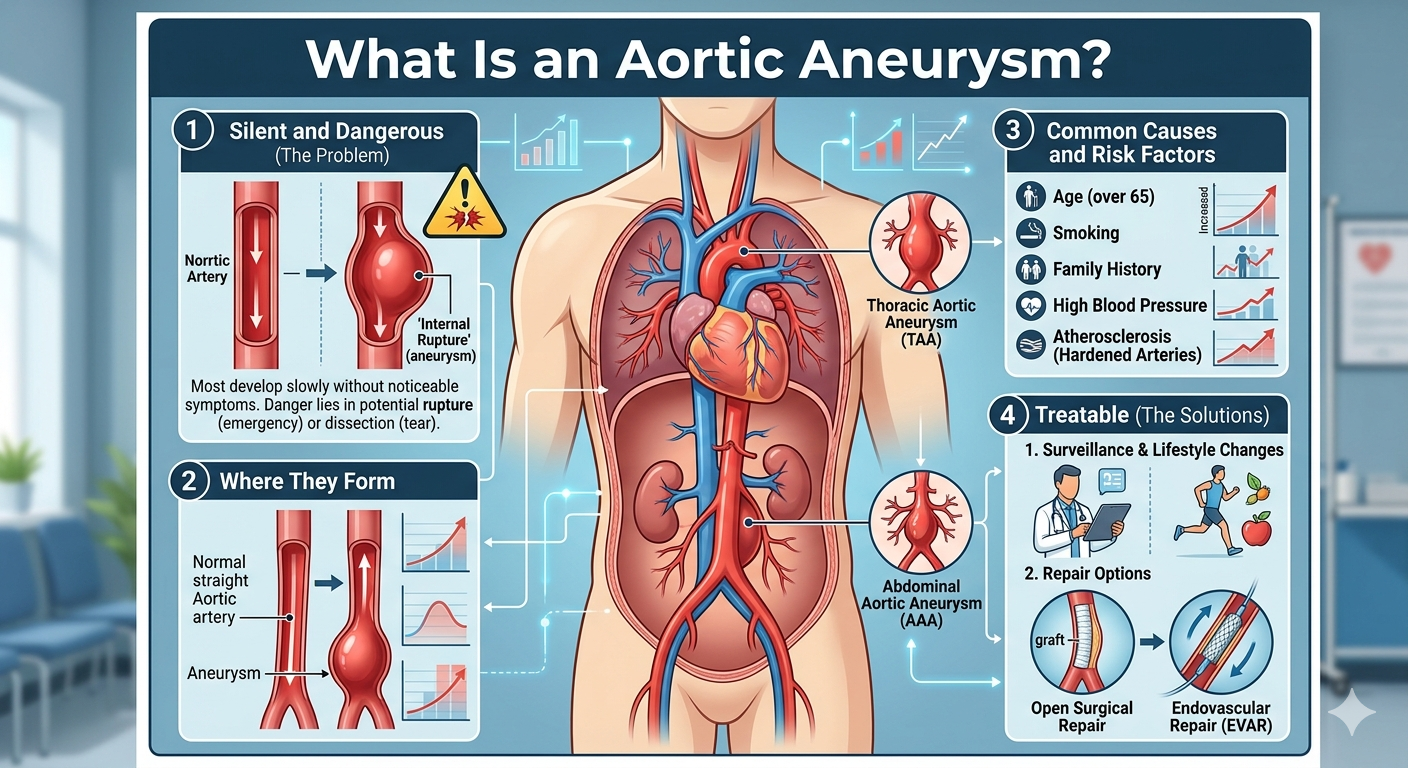
An aortic aneurysm is a ballooning in the wall of the aorta — the body’s main artery — and the most dangerous thing about it is that it causes no symptoms until it is on the verge of rupturing. Rupture of an aortic aneurysm is one of the most lethal events in medicine, with mortality exceeding 80% even with emergency surgery. The goal — always — is to find it and treat it before that moment. Dr. Ved Prakash, Director of CTVS at Yatharth Super Speciality Hospitals, Greater Noida, explains what causes an aortic aneurysm, when it needs surgery, and what the surgical options are.
What Is an Aortic Aneurysm?
The aorta is the largest artery in the body — rising from the heart, arching through the chest, and running down through the abdomen to supply the entire lower body. The normal aortic diameter is approximately 2.0–3.0 cm. An aortic aneurysm is an abnormal widening of the aorta to more than 1.5 times its normal diameter — defined as greater than 3.0 cm in the abdominal aorta or greater than 4.5 cm in the thoracic aorta.
As an aortic aneurysm enlarges, the aortic wall becomes progressively thinner and weaker. At a critical size, the wall can rupture — and the outcome is catastrophic.
Types of Aortic Aneurysm
Abdominal Aortic Aneurysm (AAA)
The most common type — a ballooning in the portion of the aorta that runs through the abdomen. AAAs occur primarily in men over 65 with a history of smoking, high blood pressure, and high cholesterol. They are almost always discovered incidentally on an ultrasound or CT scan ordered for something else entirely — because they rarely cause symptoms.
Thoracic Aortic Aneurysm (TAA)
Aortic aneurysm in the chest — affecting the ascending aorta (rising from the heart), the arch, or the descending aorta. TAAs are more commonly associated with genetic conditions including Marfan syndrome and bicuspid aortic valve, and can affect patients at younger ages than AAAs.
What Causes an Aortic Aneurysm?
- Atherosclerosis — the primary cause of AAA. Years of high blood pressure, high cholesterol, and smoking progressively weaken the aortic wall.
- Hypertension — the most important modifiable risk factor. Controlling blood pressure directly slows aneurysm growth.
- Smoking — doubles aortic aneurysm risk and accelerates growth rate significantly. The single most effective prevention is smoking cessation.
- Marfan syndrome and related connective tissue disorders — inherently weak aortic wall tissue; aneurysms can develop at younger ages and at smaller sizes than in the general population.
- Bicuspid aortic valve — associated with progressive ascending aortic enlargement; regular echocardiographic surveillance of the aortic diameter is essential.
- Family history — first-degree relatives of AAA patients have a 10–15% lifetime risk; screening ultrasound is recommended.
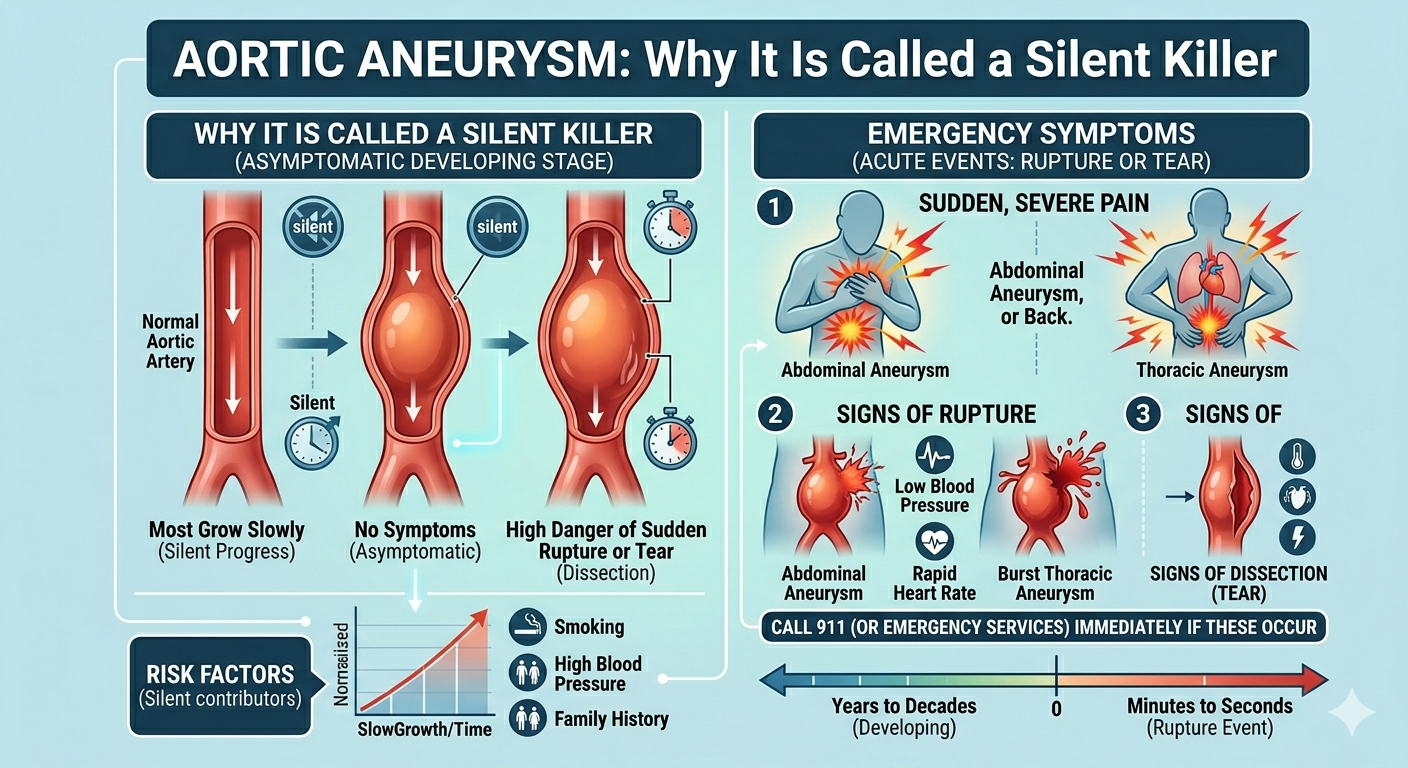
Aortic Aneurysm Symptoms — Why It Is Called a Silent Killer
The vast majority of aortic aneurysms produce no symptoms until they are large or rupturing. When symptoms do occur:
- Deep, constant back or abdominal pain — often mistaken for musculoskeletal pain. In the context of a known aortic aneurysm, this is a warning sign of rapid expansion or contained leak — requiring emergency assessment.
- Pulsating abdominal mass — a pulsating sensation in the centre of the abdomen, felt by the patient or detected on physical examination. Most clearly felt in thin patients.
- Hoarseness or difficulty swallowing — from a thoracic aneurysm pressing on the recurrent laryngeal nerve or oesophagus.
Sudden, severe tearing abdominal or back pain with collapse is rupture until proven otherwise — call emergency services immediately. This is different from the presentation of aortic dissection, which classically causes chest pain — though both are surgical emergencies.
When Does an Aortic Aneurysm Need Surgery?
The decision is based primarily on size — larger aneurysms have exponentially higher annual rupture risk:
| AAA Diameter | Annual Rupture Risk | Recommendation |
| 3.0–4.4 cm | <0.5% | Ultrasound surveillance every 12 months |
| 4.5–5.4 cm | 1–5% | Surveillance every 6 months + surgical review |
| 5.5 cm and above | 10–25% | Surgery recommended |
| Growing >1 cm per year (any size) | High | Surgery recommended regardless of size |
EVAR vs Open Surgery — What Are the Options?
EVAR — Endovascular Aneurysm Repair
A stent-graft is delivered through the femoral arteries in the groin and positioned inside the aneurysm, lining it and excluding it from the circulation. No abdominal incision. Hospital stay 2–3 days. Recovery 2–3 weeks. Requires annual CT surveillance to check the stent-graft remains in position and there is no re-pressurisation (endoleak). Suitable for most infrarenal AAAs with appropriate anatomy.
Open Surgical Repair
The aneurysm is exposed through an abdominal incision, clamped, and replaced with a synthetic Dacron graft. More invasive — hospital stay 7–10 days, recovery 6 weeks — but provides a definitive, lifelong repair that does not require ongoing CT surveillance. Required when anatomy is not suitable for EVAR, or for juxtarenal/suprarenal aneurysms.
TEVAR — Thoracic Endovascular Aortic Repair
The endovascular equivalent of EVAR for descending thoracic aortic aneurysms — a stent-graft relined the diseased thoracic aorta through femoral artery access.
For patients in Delhi NCR with a newly diagnosed or enlarging aortic aneurysm, aortic surgery in Delhi NCR at Yatharth Hospital covers the full range — EVAR, TEVAR, and open surgical repair. CT reports can be shared via WhatsApp for a pre-assessment before your visit.
Frequently Asked Questions — What Is Aortic Aneurysm
What is an aortic aneurysm and is it always fatal?
An aortic aneurysm is an abnormal ballooning of the aortic wall. It is not immediately fatal — most detected aneurysms are small and slow-growing and can be treated safely with elective surgery before rupture. A ruptured aneurysm carries mortality above 80%. Finding it early is what saves lives.
At what size does an aortic aneurysm need surgery?
Surgery is generally recommended when an abdominal aortic aneurysm reaches 5.5 cm or when it grows more than 1 cm in 12 months. Below this, surveillance ultrasound every 6–12 months is the standard approach.
What is EVAR and how is it different from open surgery?
EVAR delivers a stent-graft through the groin without opening the abdomen — hospital stay 2–3 days. Open surgery replaces the aneurysm through an abdominal incision — hospital stay 7–10 days. EVAR is preferred when anatomy allows; open surgery for complex anatomy or younger patients needing a permanent repair.
What are the symptoms of an aortic aneurysm?
Most cause no symptoms — found incidentally on imaging. When symptoms occur: deep back or abdominal pain, pulsating abdominal mass, or hoarseness. Sudden severe pain with collapse suggests rupture — a surgical emergency.
Dr. Ved Prakash | Director, CTVS — Yatharth Super Speciality Hospitals, Greater Noida
📞 +91-9355255106 |
📧 drvedprakash@gmail.com |
Book Appointment →