
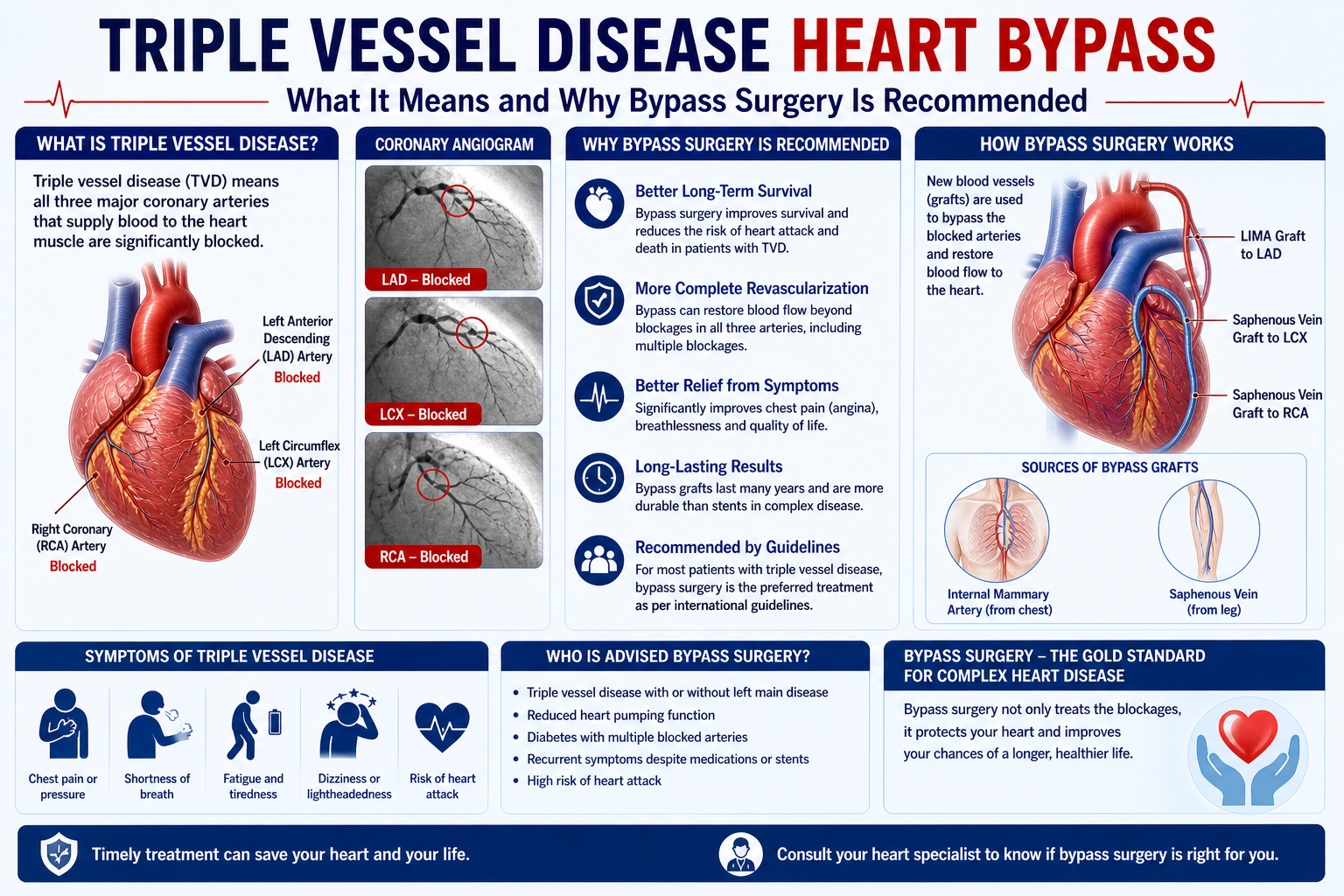
Triple vessel disease means all three of your major coronary arteries have significant blockages — and it is the diagnosis that most consistently points toward bypass surgery as the right treatment. If your cardiologist has just told you that you have triple vessel disease, this article explains what it means, why it is more serious than single or double vessel disease, and what the evidence says about treatment. Dr. Ved Prakash, Director of CTVS at Yatharth Super Speciality Hospitals, Greater Noida, treats triple vessel disease patients referred from across Delhi NCR, UP, and Uttarakhand.
Triple vessel disease means all three of these arteries have a stenosis of 70% or more — significant enough to restrict blood flow, cause symptoms on exertion, and put the heart at risk of heart attack. When your cardiologist says you have triple vessel disease, they mean blockages are present across the entire coronary circulation — not just one section of the heart.
Why Triple Vessel Disease Is More Dangerous Than Single or Double Vessel Disease
With single vessel disease, a blockage in one artery threatens one region of the heart muscle. The other two arteries can partially compensate. With triple vessel disease, all three territories are simultaneously at risk. There is no compensatory reserve. A plaque rupture in any of the three arteries can cause a large heart attack — and the cumulative burden of reduced blood flow to the entire heart progressively damages the left ventricular muscle over time, leading to heart failure.
Additionally, triple vessel disease is strongly associated with:
- Reduced ejection fraction— the heart’s pumping function declines as all three territories are chronically under-supplied
- Higher risk of ventricular arrhythmia — from widespread ischaemia affecting the heart’s electrical stability
- More rapid symptom progression — angina that is difficult to control with medication alone
Why Bypass Surgery Is the Recommended Treatment for Triple Vessel Disease
This is the most critical piece of information for patients who have just received this diagnosis.
Multiple large randomised trials have compared bypass surgery against angioplasty specifically in triple vessel disease. The consistent finding across the SYNTAX trial, the FREEDOM trial (in diabetics), and the NOBLE trial is that bypass surgery delivers significantly better outcomes at 5 and 10 years — lower rates of heart attack, lower mortality, and dramatically fewer repeat procedures.
The reason is anatomical and mechanical. Bypass surgery creates new blood vessel routes that bypass all three blockages simultaneously — restoring near-normal blood supply to the entire heart muscle. The LIMA graft to the LAD alone has a 90%+ patency rate at 15 years. Angioplasty places metal stents inside the diseased vessels — which remain in place and are subject to restenosis (re-blockage) at higher rates, particularly in diabetics. In triple vessel disease, the cumulative restenosis risk across multiple stents is unacceptably high.
When Bypass Surgery Is Most Strongly Preferred
| Factor | Why It Strengthens the Case for Bypass |
| Diabetes | FREEDOM trial: bypass reduced death and heart attack by 51% vs angioplasty in diabetic triple vessel disease at 5 years |
| High SYNTAX score (≥33) | Complex anatomy — angioplasty outcomes are markedly inferior at high SYNTAX scores |
| Reduced ejection fraction (<50%) | Bypass achieves more complete revascularisation — particularly important when the heart muscle is already struggling |
| LAD involvement | LIMA-to-LAD graft lasts 15–20 years — stents in LAD have significantly higher restenosis rates |
| Age under 70 | Younger patients benefit most from the graft durability of bypass — fewer re-procedures over their lifetime |
Can Angioplasty Treat Triple Vessel Disease?
Angioplasty is technically feasible in triple vessel disease and is appropriate in a small subset of patients — specifically those with low SYNTAX scores, non-diabetics, and those with very high surgical risk due to other medical conditions. In these patients, a Heart Team discussion determines whether angioplasty’s lower procedural risk outweighs bypass surgery’s better long-term outcomes.
<span”>For the majority of triple vessel disease patients — particularly diabetics, those with high SYNTAX scores, or those with any degree of impaired heart function — angioplasty is not the guideline-recommended treatment. If you have been offered angioplasty for triple vessel disease and you are diabetic or have a high SYNTAX score, you are entitled to ask for a cardiac surgeon’s opinion before proceeding.
What Happens If Triple Vessel Disease Is Not Treated
Medical therapy alone (aspirin, statins, beta-blockers, blood pressure medications) reduces heart attack risk but does not provide the survival benefit of revascularisation in symptomatic triple vessel disease. Untreated, progressive triple vessel disease leads to:
-
- Increasing angina frequency and severity — until medication can no longer control symptoms
- Progressive decline in ejection fraction — from chronic ischaemia starving the heart muscle
- Heart attack — which in triple vessel disease often involves a large territory of heart muscle
- Heart failure — requiring hospitalisation and long-term management

</ul
ong>The evidence for revascularisation improving survival in triple vessel disease is unambiguous — which is why the diagnosis triggers an urgent cardiac surgical consultation in every guideline-based cardiac programme.
For a detailed explanation of how the decision between bypass surgery and angioplasty is made — including the SYNTAX score and Heart Team process — read the complete guide on why bypass surgery is preferred over angioplasty in triple vessel disease. To book a consultation for bypass surgery in Delhi NCR, share your angiogram report via WhatsApp at +91-9355255106 for a pre-assessment before visiting.
Frequently Asked Questions — Triple Vessel Disease Heart Bypass
What is triple vessel disease of the heart?
Significant blockages (typically 70% or more) in all three major coronary arteries — the LAD, LCx, and RCA. The most advanced form of multi-vessel coronary artery disease, carrying the highest risk of heart attack and heart failure without treatment.
Is bypass surgery always necessary for triple vessel disease?
For most patients — especially diabetics, those with high SYNTAX scores, and those with any degree of impaired heart function — bypass surgery is strongly recommended over angioplasty. The SYNTAX, FREEDOM, and NOBLE trials all confirm superior long-term outcomes with bypass in this setting.
What happens if triple vessel disease is not treated?
Progressive angina, declining heart muscle function (falling ejection fraction), increasing risk of large heart attack, and eventual heart failure. Medical therapy alone does not provide the survival benefit of revascularisation in symptomatic triple vessel disease.
Can angioplasty treat triple vessel disease?
Technically possible in selected patients with low SYNTAX scores and non-diabetics. Not the guideline-recommended treatment for most — particularly diabetics and those with complex anatomy. Always requires Heart Team review before deciding.
Dr. Ved Prakash | Director, CTVS — Yatharth Super Speciality Hospitals, Greater Noida
📞 +91-9355255106 |
📧 drvedprakash@gmail.com |
Book Appointment →