
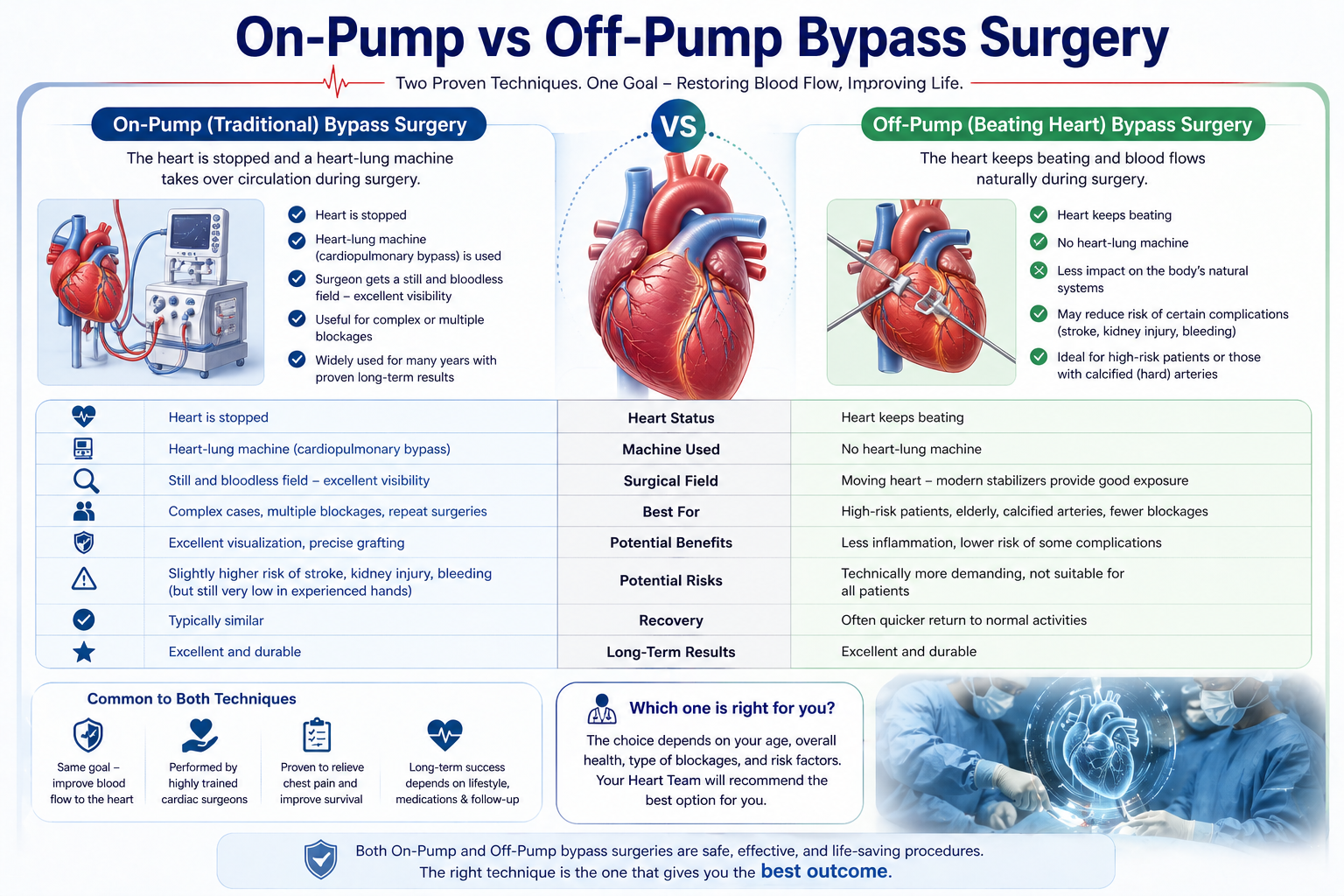
On-pump vs off-pump bypass surgery is one of the most specific questions patients ask before CABG — and it is a genuinely important one, because the right technique depends directly on your individual health profile. Dr. Ved Prakash, Director of CTVS at Yatharth Super Speciality Hospitals, Greater Noida, has extensive experience with both techniques and explains how the on-pump vs off-pump bypass surgery decision is made — and what it means for your recovery.
What Is On-Pump Bypass Surgery?
In on-pump bypass surgery, the heart is temporarily stopped using a special medication (cardioplegia solution), and a heart-lung machine (cardiopulmonary bypass machine) takes over the job of circulating and oxygenating the blood while the surgeon operates. Because the heart is completely still, the surgeon can work with great precision in placing the bypass grafts.
On-pump bypass surgery is the standard, time-tested technique that has been performed since the 1960s. It remains the default approach for most complex CABG operations worldwide — and it delivers excellent, consistent outcomes.
What Is Off-Pump Bypass Surgery (OPCAB)?
In off-pump bypass surgery — also called OPCAB or beating-heart bypass — the bypass grafts are attached while the heart continues to beat. No heart-lung machine is used. The surgeon uses mechanical stabilisers to gently immobilise a small area around the target coronary artery while the rest of the heart beats normally.
Off-pump bypass surgery is technically more demanding — it requires greater surgical skill and experience than the standard on-pump technique. But in the right patients and the right hands, it offers meaningful advantages.
On-Pump vs Off-Pump Bypass Surgery — Key Differences
| Feature | On-Pump CABG | Off-Pump CABG (OPCAB) |
| Heart-lung machine used? | Yes | No |
| Heart stopped during surgery? | Yes | No — heart continues to beat |
| Surgical complexity | Standard | Higher — requires specialised technique |
| Kidney complication risk | Slightly higher | Reduced in pre-existing kidney disease |
| Stroke risk | Slightly higher in aortic calcification | Potentially lower in high-risk patients |
| Blood transfusion need | Slightly higher | Often lower |
| Graft completeness | Easier to achieve all targets | Some posterior targets technically harder |
| Overall outcome | Excellent | Equivalent in experienced hands |
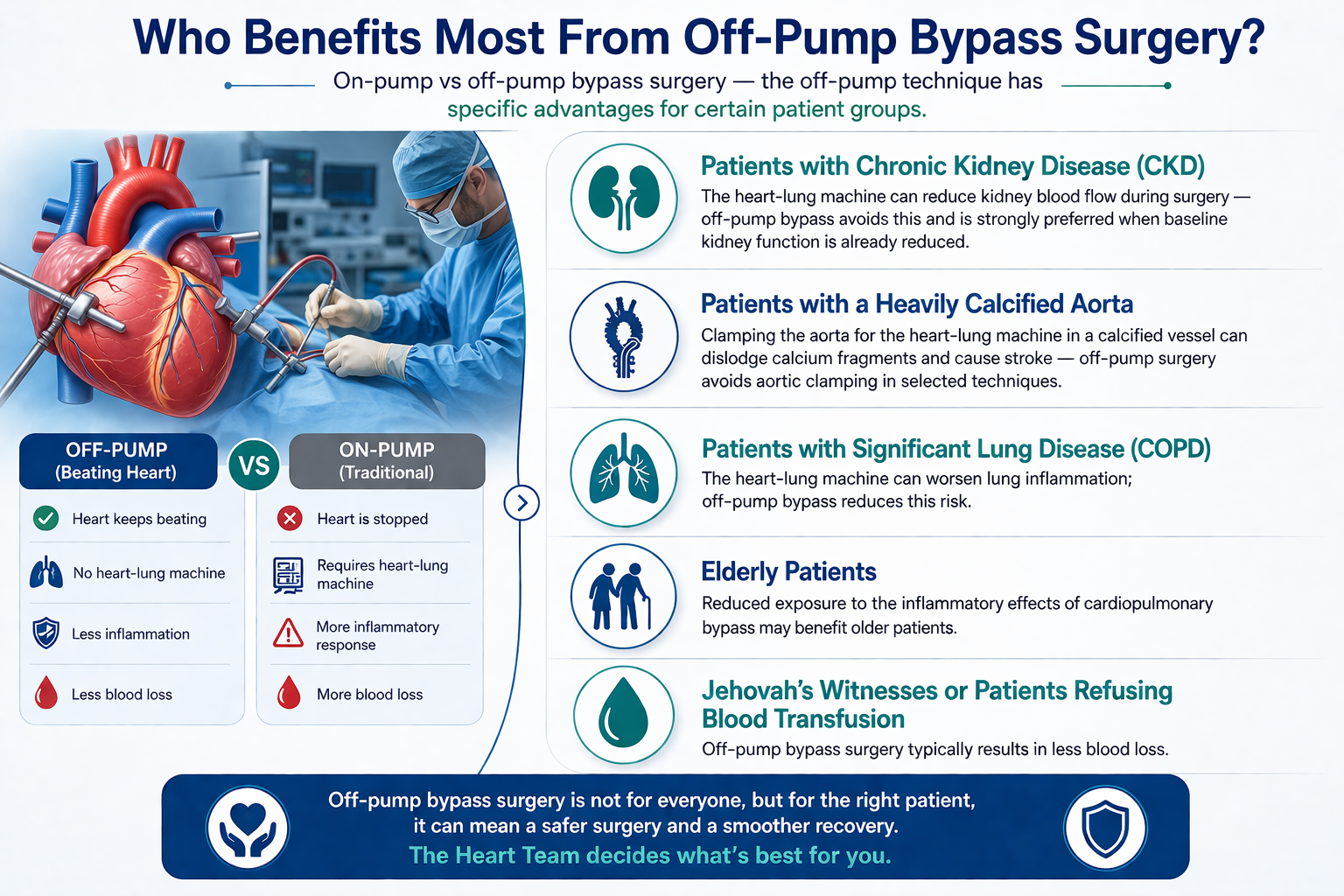
Who Benefits Most From Off-Pump Bypass Surgery?
On-pump vs off-pump bypass surgery — the off-pump technique has specific advantages for certain patient groups:
- Patients with chronic kidney disease (CKD): The heart-lung machine can reduce kidney blood flow during surgery — off-pump bypass avoids this and is strongly preferred when baseline kidney function is already reduced
- Patients with a heavily calcified aorta: Clamping the aorta for the heart-lung machine in a calcified vessel can dislodge calcium fragments and cause stroke — off-pump surgery avoids aortic clamping in selected techniques
- Patients with significant lung disease (COPD): The heart-lung machine can worsen lung inflammation; off-pump bypass reduces this risk
- Elderly patients: Reduced exposure to the inflammatory effects of cardiopulmonary bypass may benefit older patients
- Jehovah’s Witnesses or patients refusing blood transfusion: Off-pump bypass surgery typically results in less blood loss
Who Is Better Suited to On-Pump Bypass Surgery?
In the on-pump vs off-pump bypass surgery comparison, on-pump is preferred when:
- The coronary arteries to be bypassed are in technically difficult positions (particularly posterior vessels on the back of the heart) that are harder to stabilise in a beating heart
- The heart is already significantly enlarged or weak — making stabilisation for off-pump technically challenging
- The operation needs to be combined with another procedure simultaneously (e.g., valve repair or aortic surgery)
- The surgeon’s experience is primarily with the on-pump technique — surgeon experience matters more than technique choice
The Most Important Factor — Surgeon Experience
The on-pump vs off-pump bypass surgery debate in the medical literature largely resolves to one conclusion: in experienced hands, both techniques deliver equivalent long-term graft patency and mortality rates. The difference is in short-term kidney and neurological complication rates — which benefit specific patient subgroups with off-pump surgery.
What this means practically: the technique that is safer for you is the one your surgeon has the most experience with, applied to your specific anatomy and health profile. Dr. Ved Prakash discusses this choice openly with every patient before surgery.
Frequently Asked Questions — On-Pump vs Off-Pump Bypass Surgery
What is the difference between on-pump and off-pump bypass surgery?
In on-pump bypass surgery, a heart-lung machine temporarily takes over the heart’s function while the surgeon operates on a still heart. In off-pump bypass surgery, the grafts are attached while the heart continues to beat — no heart-lung machine is used. Both produce excellent outcomes in the right patient.
Is off-pump bypass surgery safer than on-pump?
Off-pump bypass surgery reduces kidney complication risk and may lower stroke risk in high-risk patients. However, it is technically more demanding and requires greater surgical experience. In experienced hands, both techniques deliver equivalent overall outcomes for most patients.
Who is off-pump bypass surgery best for?
Patients with pre-existing kidney disease, heavily calcified aortas, significant lung disease, or those at elevated risk of neurological complications from the heart-lung machine benefit most from off-pump bypass surgery.
Can all blockages be bypassed in off-pump surgery?
Most coronary artery blockages can be bypassed off-pump by an experienced surgeon. However, certain anatomical locations — particularly vessels on the back of the heart — are more challenging. If complete revascularisation cannot be achieved off-pump, conversion to on-pump surgery is performed without any compromise to safety.
For more on bypass surgery in general, read our complete guide on bypass surgery vs angioplasty — or book a consultation for bypass surgery in Delhi NCR.
Dr. Ved Prakash | Director CTVS — Yatharth Super Speciality Hospitals, Greater Noida
📞 +91-9355255106 |
Book Appointment →