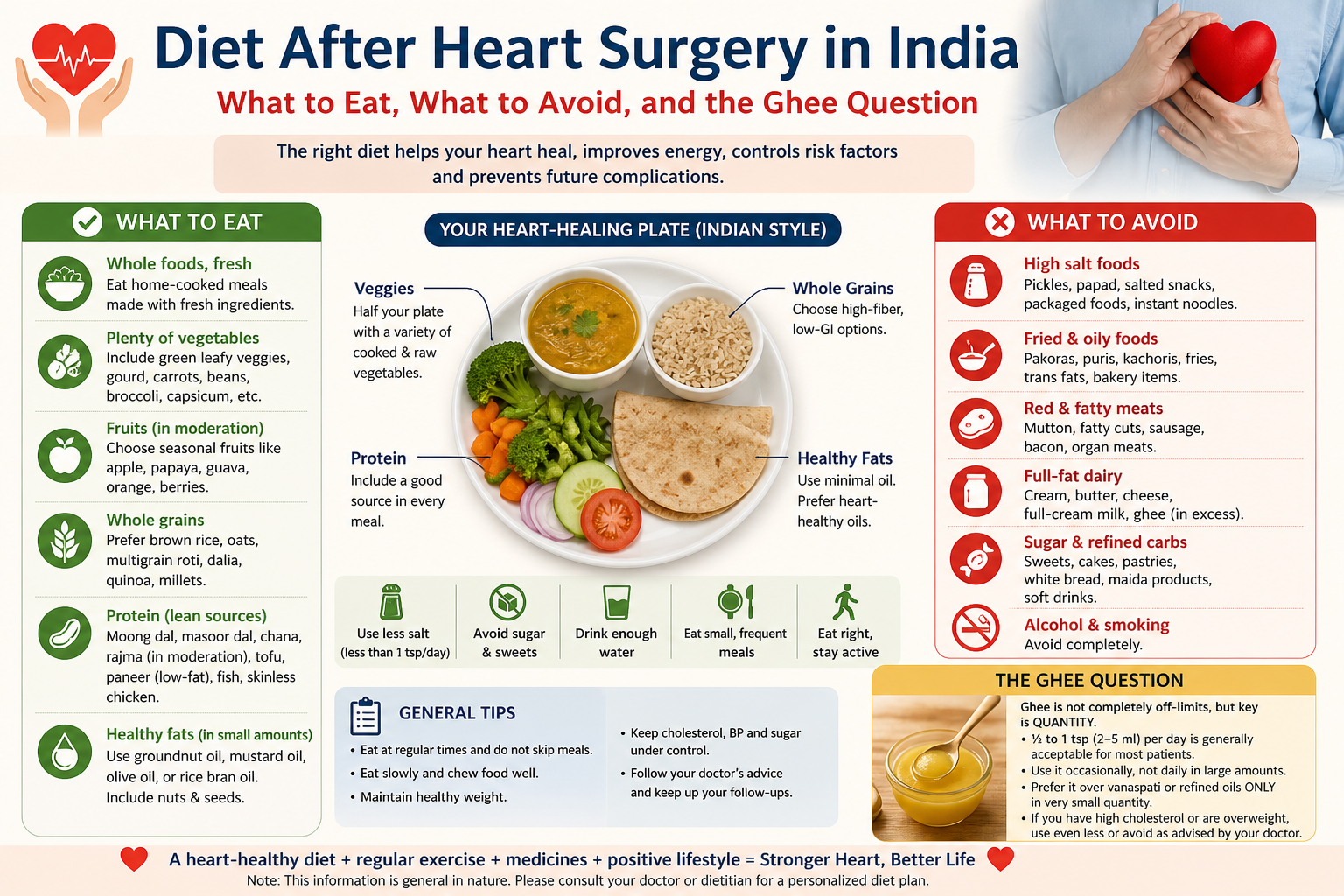
 Diet after heart surgery in India is the question that almost every patient and family asks at discharge — and the advice they receive is usually so generic (“eat healthy, avoid oil”) that it is practically useless for someone cooking Indian food at home. Dr. Ved Prakash, Director of CTVS at Yatharth Super Speciality Hospitals, Greater Noida, gives you the complete, practical India-specific guide — what to eat, what to avoid, what to do with ghee, and the most common mistakes patients make in the months after bypass or valve surgery.
Why Diet After Heart Surgery in India Matters More Than Patients Realise
Bypass grafts, stents, and repaired heart valves do not last forever by default. How long they last is significantly influenced by what happens to the coronary arteries and heart in the years after surgery. A poor diet accelerates plaque formation in grafted vessels, raises cholesterol, elevates blood pressure, and worsens blood sugar control. The operation buys you time and relief — your diet determines how many years that time lasts.
The goal of diet after heart surgery in India is not punishment. It is making choices that protect what the surgeon created. For more on the broader picture of recovery, read about life after bypass surgery — week by week.
What to Eat After Heart Surgery in India
Grains and Rotis
Best: Whole wheat roti (2–3 per meal), jowar roti, bajra roti, oats, daliya (broken wheat porridge), brown rice in moderate portions. These provide slow-digesting carbohydrates, fibre, and sustained energy without spiking blood sugar.
Avoid: Maida-based products — puri, paratha made from maida, naan, white bread, biscuits. White rice in large quantities is acceptable occasionally but should not be the daily staple, particularly for diabetic bypass patients.
Protein — Critical in the First 3 Months
The sternum (breastbone) takes 6–8 weeks to heal after bypass surgery. Adequate protein is essential for this healing and for overall recovery. Indian diets are often protein-deficient — this must be corrected deliberately after surgery.
- Dal: 1–2 katori per day — moong, masoor, chana, toor. All excellent. The combination of dal and roti provides complete protein.
- Paneer: Low-fat paneer in moderate amounts — 50–75 grams per day is fine. Full-fat paneer in large quantities daily is too high in saturated fat.
- Curd (dahi): Plain, low-fat curd — excellent daily protein source and probiotic. Not sweetened.
- Eggs: 1 whole egg daily is acceptable for most patients. Egg white can be taken freely — no yolk restriction for patients whose cholesterol is controlled.
- Fish: Rohu, katla, sardine, mackerel — 3–4 times per week, grilled or steamed. Omega-3 rich and heart-protective.
- Chicken: Grilled or boiled breast, without skin — good lean protein source. Not fried.
Vegetables
No meaningful restriction on vegetables. Include 3–4 varieties daily — emphasis on green leafy vegetables (palak, methi, pudina), tomatoes, onions, garlic, bitter gourd (karela — helps blood sugar control). All sabzis should be cooked in 1 teaspoon of oil maximum per preparation.
Fruits
Two portions daily: guava, apple, papaya, orange, amla, berries. For diabetic bypass patients: avoid mango, banana, and chikoo in quantity — high sugar content. Amla deserves special mention — it is exceptionally high in vitamin C, which supports vessel integrity and wound healing.
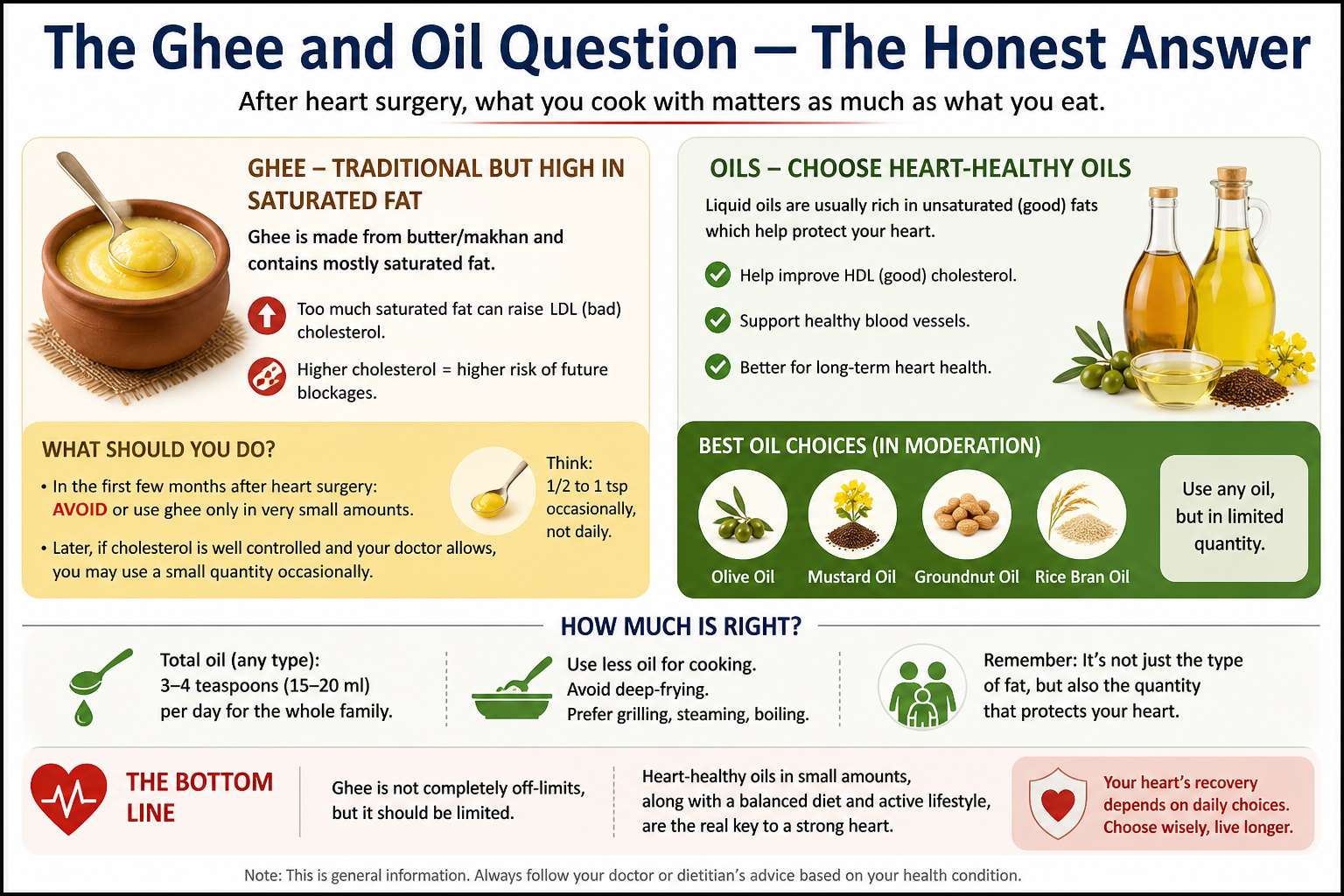
The Ghee and Oil Question — The Honest Answer
This is the most frequently debated area of diet after heart surgery in India, and the most frequently over-simplified.
Going completely oil-free after heart surgery is wrong. Dietary fat is essential for absorbing fat-soluble vitamins A, D, E, and K. Vitamin D deficiency — already epidemic in India — worsens after heart surgery if fat is eliminated from the diet. Patients who go oil-free often compensate by eating more refined carbohydrates, which raise triglycerides and blood sugar — both harmful to bypass grafts.
The right approach to oil and ghee:
- Use 2–3 teaspoons total of oil per day in cooking — not per dish, per day
- Best oils: mustard oil, groundnut oil, rice bran oil. Olive oil is good but expensive for everyday Indian cooking and changes the flavour of dal.
- Avoid vanaspati (dalda), palm oil, and reused or overheated cooking oil
- Small amounts of homemade ghee — half a teaspoon occasionally — are not harmful for most patients. Commercially produced ghee or large daily quantities should be avoided.
Coconut oil in large amounts (as used in Kerala cooking) is high in saturated fat and should be reduced after heart surgery
 If You Are on Warfarin After Valve Surgery — The Green Vegetable Issue
Patients who have had a mechanical heart valve replacement take warfarin for life. Warfarin interacts with vitamin K, which is found in green leafy vegetables — palak, methi, sarson, dhania, pudina. The critical point: you do not need to avoid these vegetables. You need to eat a consistent amount of them week to week. If you have been eating palak twice a week and you suddenly eat it every day for a week, your INR will drop. If you suddenly stop eating green vegetables, it will rise. Consistency is the rule — not avoidance.
What to Strictly Avoid After Heart Surgery in India
- Namkeen, papad, pickle, achar: Extremely high in sodium — raises blood pressure directly
- Restaurant and dhaba food: Unknown oil quality, very high sodium, very high fat — avoid for at least 6 months
- Fried foods of any kind: Puri, samosa, pakora, chips — eliminated for 12 months minimum
- Mithai and sweetened drinks: High sugar and saturated fat — particularly harmful for diabetic bypass patients. This includes packaged fruit juices.
- Alcohol: Avoid completely for 3 months minimum post-surgery. After that, maximum 1 standard drink per day if the cardiologist permits — and never if on warfarin without discussion with your doctor.
Heart-Protective Foods to Add Daily
- Garlic: 2–3 raw or cooked cloves — modest LDL-lowering and antiplatelet effect
- Flaxseeds (alsi): 1 tablespoon ground daily — best plant-based omega-3 source in India
- Walnuts (akhrot): 4–5 daily — omega-3, vitamin E, anti-inflammatory
- Methi (fenugreek) seeds: Soaked overnight, taken in the morning — supports blood sugar and cholesterol control
- Amla: 1 fresh amla or 1 teaspoon amla powder daily — outstanding vitamin C source
For the full picture of what life looks like after bypass surgery — including activity, return to work, and long-term follow-up — read the complete bypass surgery recovery guide.
Frequently Asked Questions — Diet After Heart Surgery India
Can I eat dal roti after bypass surgery?
Yes — one of the best daily meals after bypass surgery. Dal provides plant protein and fibre; whole wheat roti provides complex carbohydrates. Use minimal oil in the tadka and no high-sodium powdered masalas.
Can I eat ghee after heart surgery?
Small, occasional amounts of homemade ghee are acceptable. Daily large-quantity ghee is not. Going completely oil-free is also wrong. 2–3 teaspoons of good-quality oil per day is the target — ghee can be one of those teaspoons occasionally.
What fish can I eat after heart surgery in India?
Rohu, katla, sardine, and mackerel — grilled or steamed, 3–4 times per week. Excellent omega-3 source, heart-protective, and well-suited to Indian cooking methods.
If I am on warfarin after valve surgery, are there foods to avoid?
You do not need to avoid green leafy vegetables — you need to eat a consistent amount week to week. Sudden large changes in intake of palak, methi, or other vitamin K-rich vegetables will shift your INR. Consistency is the rule, not avoidance.
Dr. Ved Prakash | Director, CTVS — Yatharth Super Speciality Hospitals, Greater Noida
📞 +91-9355255106 |
📧 drvedprakash@gmail.com |
Book Appointment →