
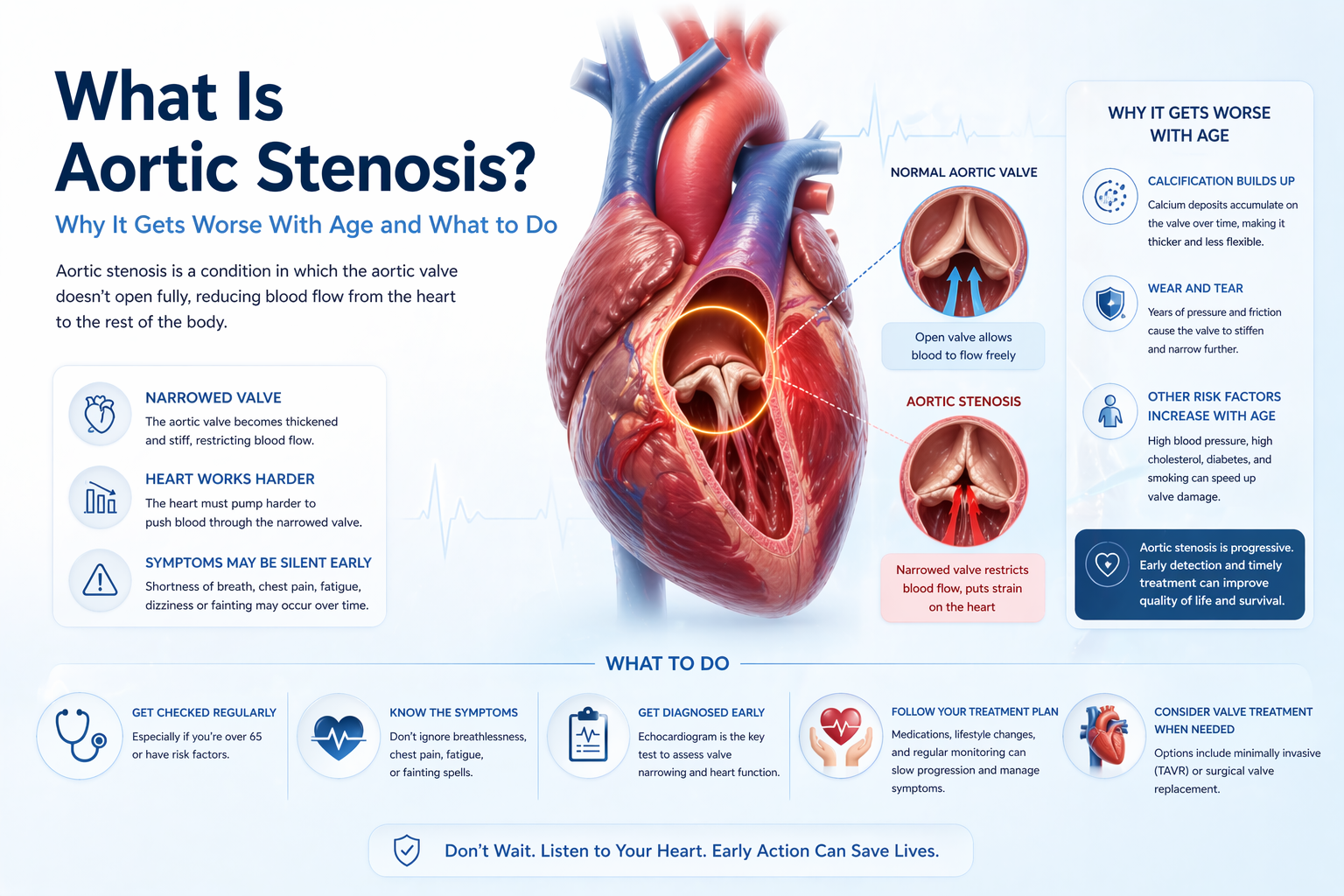
Aortic stenosis is a condition where the aortic valve — the valve between the heart and the body’s main artery — becomes stiff, calcified, and narrowed over time, forcing the heart to push blood through an increasingly small opening. It is the most common heart valve condition in adults over 65, and it gets progressively worse with every passing year without treatment.
Dr. Ved Prakash, Director of CTVS at Yatharth Super Speciality Hospitals, Greater Noida, explains what aortic stenosis means, why it is dangerous if left untreated, and what surgical and catheter-based treatment options are now available in Delhi NCR.
What Is Aortic Stenosis — Simply Explained
The aortic valve has three thin leaflets that open wide with each heartbeat to let blood pass from the left ventricle into the aorta (the body’s main artery), then close tightly to prevent it flowing back. In aortic stenosis, calcium deposits accumulate on these leaflets over decades — stiffening and fusing them together.
The result is an increasingly narrow valve opening. The heart’s left ventricle must squeeze much harder to push blood through this narrowed gap. Over years, this extra workload thickens and stiffens the heart muscle — until eventually the heart can no longer compensate, and symptoms appear. Once symptoms appear, the condition becomes rapidly life-threatening without intervention.
What Causes Aortic Stenosis?
- Age-related calcification: The most common cause in patients over 65. Years of wear cause calcium to deposit on the valve leaflets, progressively narrowing the opening. This process is similar to atherosclerosis (artery hardening) and shares the same risk factors.
- Bicuspid aortic valve: Normally the aortic valve has three leaflets. Approximately 1–2% of people are born with only two (bicuspid). This abnormal valve wears out and calcifies much earlier — often causing significant stenosis in patients aged 40–60 rather than 65–80.
- Rheumatic heart disease: Childhood streptococcal infection causing rheumatic fever can scar the aortic valve — a significant cause in India in patients now aged 30–60.
Aortic Stenosis Symptoms — The Three Cardinal Signs
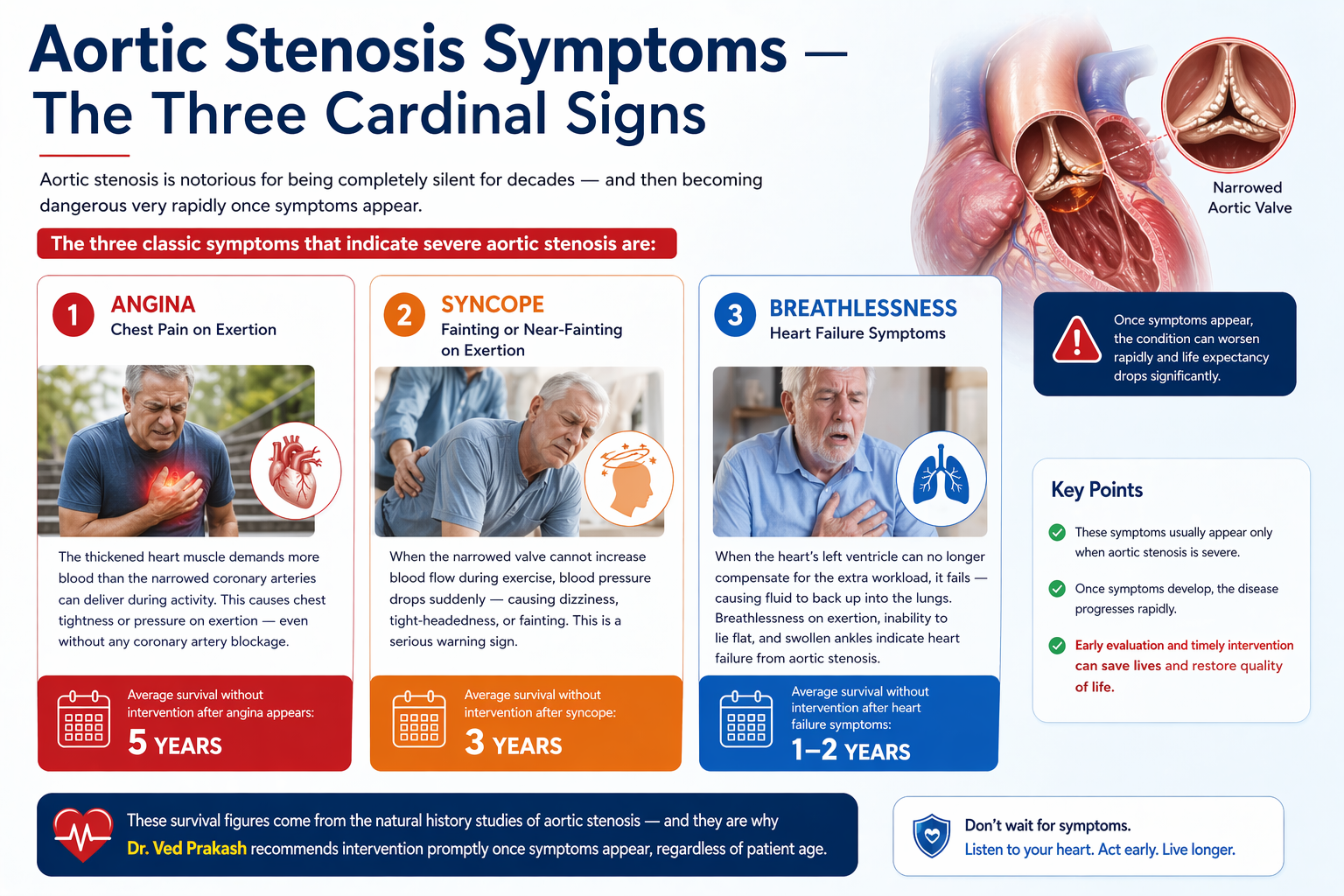
Aortic stenosis is notorious for being completely silent for decades — and then becoming dangerous very rapidly once symptoms appear. The three classic symptoms that indicate severe aortic stenosis are:
1. Angina — Chest Pain on Exertion
The thickened heart muscle demands more blood than the narrowed coronary arteries can deliver during activity. This causes chest tightness or pressure on exertion — even without any coronary artery blockage. Average survival without intervention after angina appears: 5 years.
2. Syncope — Fainting or Near-Fainting on Exertion
When the narrowed valve cannot increase blood flow during exercise, blood pressure drops suddenly — causing dizziness, light-headedness, or fainting. This is a serious warning sign. Average survival without intervention after syncope: 3 years.
3. Breathlessness — Heart Failure Symptoms
When the heart’s left ventricle can no longer compensate for the extra workload, it fails — causing fluid to back up into the lungs. Breathlessness on exertion, inability to lie flat, and swollen ankles indicate heart failure from aortic stenosis. Average survival without intervention after heart failure symptoms: 1–2 years.
These survival figures come from the natural history studies of aortic stenosis — and they are why Dr. Ved Prakash recommends intervention promptly once symptoms appear, regardless of patient age.
How Is Aortic Stenosis Diagnosed?
- Stethoscope: A characteristic harsh systolic murmur is audible — often the first clue
- Echocardiogram: The definitive investigation — measures the valve area, the pressure gradient across the valve, and the heart’s ejection fraction (pumping function)
- CT angiography: Needed before TAVI to plan the procedure precisely
- Coronary angiography: Performed before surgical valve replacement in patients over 50 to check for coincidental coronary blockages
Treatment Options for Aortic Stenosis in Delhi NCR
Surgical Aortic Valve Replacement (SAVR)
Open-heart surgery to remove the calcified native valve and replace it with a mechanical or biological prosthetic valve. The gold standard for younger patients (under 70–75) who are suitable for open surgery. Performed under general anaesthesia through a chest incision.
TAVI — Transcatheter Aortic Valve Implantation
A catheter-based procedure that delivers a replacement valve through the femoral artery in the groin — no chest incision required. For elderly patients or those with significant comorbidities that make open surgery high-risk, TAVI surgery in Delhi NCR offers equivalent outcomes to open surgery with dramatically faster recovery — most patients are discharged in 3–5 days and walking within 24 hours.
Every patient at Yatharth Hospital is assessed by a multidisciplinary Heart Team before a recommendation is made — the anatomy and the patient’s overall health determine whether open surgery or TAVI is the right choice.
Frequently Asked Questions — What Is Aortic Stenosis
What is aortic stenosis and is it serious?
Aortic stenosis is a progressive narrowing of the aortic heart valve. Once it reaches a severe stage and symptoms appear, it is serious — the average survival without treatment is 1–5 years depending on which symptoms are present. With timely surgery or TAVI, most patients recover well and live a normal lifespan.
Can aortic stenosis be treated without surgery?
No effective medication can open a calcified aortic valve or slow its progression significantly. Medications manage symptoms temporarily but cannot change the outcome. Surgical valve replacement or TAVI is the only definitive treatment.
At what age does aortic stenosis usually need treatment?
Age-related calcific aortic stenosis typically requires treatment in the late 60s to 80s. Bicuspid aortic valve disease often requires intervention earlier — in the 40s to 60s. Rheumatic aortic stenosis can appear from the 30s onwards in India.
How is aortic stenosis different from aortic regurgitation?
Aortic stenosis means the valve is too narrow and restricts blood flow out of the heart. Aortic regurgitation means the valve leaks and blood flows backwards into the heart from the aorta. Both eventually damage the heart muscle but through different mechanisms. Both may require surgery or valve replacement.
Is TAVI available for aortic stenosis in Delhi NCR?
Yes. TAVI surgery is available at Yatharth Super Speciality Hospitals, Greater Noida, performed by Dr. Ved Prakash. Every candidate is assessed by a Heart Team before the procedure is recommended. Suitability depends on the valve anatomy and the patient’s overall health as assessed by CT angiography.
Act Before Symptoms Worsen — Get an Assessment Today
If an echocardiogram has shown aortic stenosis — even without symptoms — monitoring is essential and the timing of intervention matters significantly. Consult Dr. Ved Prakash for heart valve surgery in Delhi NCR at Yatharth Hospital. Echo reports can be shared via WhatsApp for an online pre-assessment.
Dr. Ved Prakash | Director CTVS — Yatharth Super Speciality Hospitals, Greater Noida
📞 +91-9355255106 |
Book Appointment →