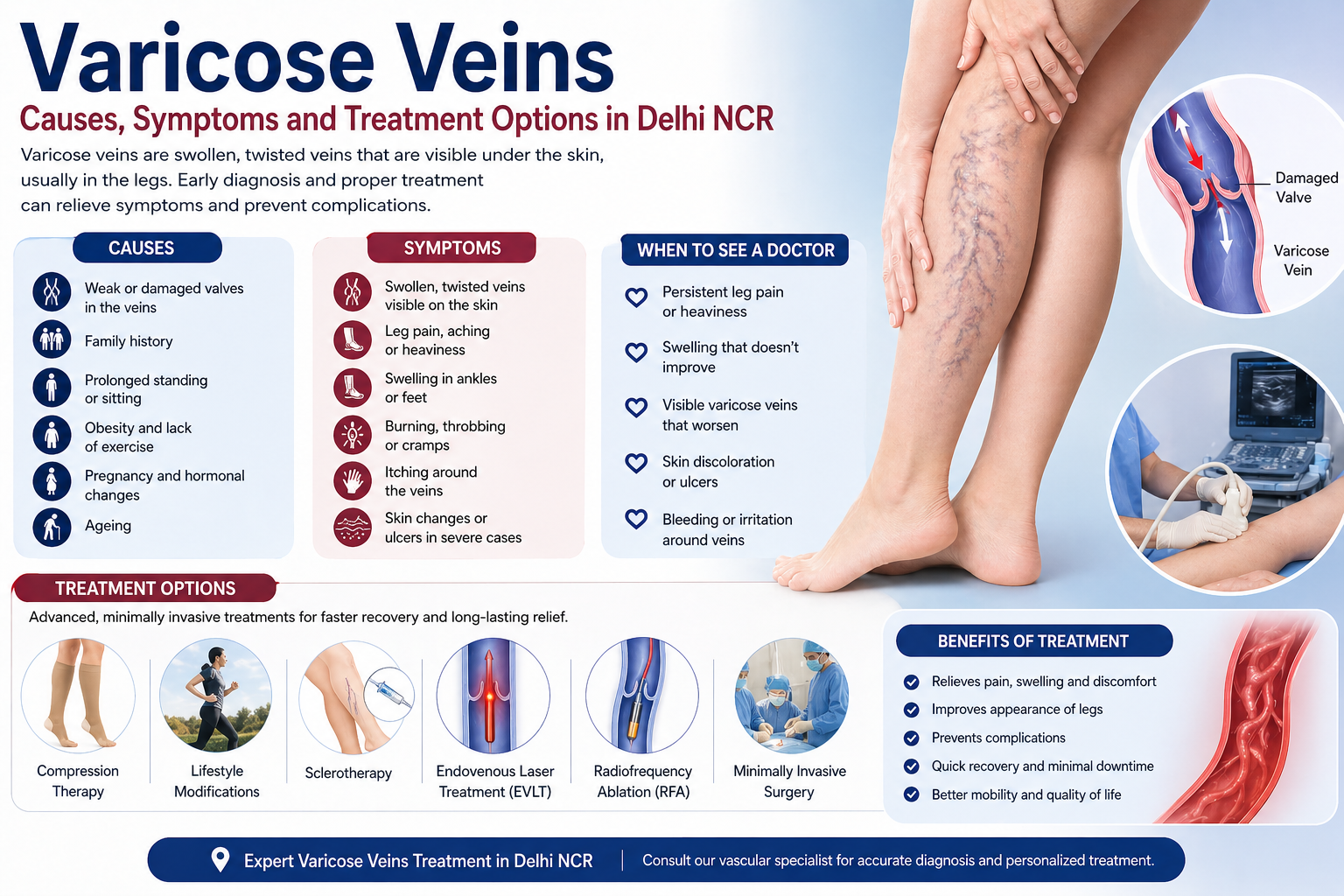
Varicose veins are not just a cosmetic problem — varicose veins causes include damaged vein valves that allow blood to pool in your legs, and without treatment, they can progress to skin ulcers, bleeding, and deep vein thrombosis. Dr. Ved Prakash, Director of CTVS and Vascular Surgery at Yatharth Super Speciality Hospitals, Greater Noida, explains varicose veins causes, symptoms, when they become medically serious, and what treatment options are available in Delhi NCR.
What Are Varicose Veins?
Veins carry blood from the legs back to the heart — working against gravity. To prevent blood from flowing backwards, veins contain one-way valves that open when blood flows upward and close between heartbeats. When these valves weaken or are damaged, blood pools in the vein between beats — causing the vein to stretch, enlarge, and become twisted. The result is a varicose vein.
Varicose veins are most common in the long saphenous vein system — the large superficial vein running from the foot to the groin along the inner leg. They appear as bulging, rope-like blue or purple veins visible under the skin, most commonly in the calf and thigh.
Varicose Veins Causes — Why They Develop
Understanding varicose veins causes helps identify who is most at risk. The primary mechanism is always weakened or incompetent vein valves — but several factors make this more likely:
Primary Varicose Veins Causes
- Prolonged standing or sitting: The most significant occupational risk factor. Teachers, nurses, surgeons, security guards, factory workers, and retail staff who stand for 6+ hours daily have significantly higher rates of varicose vein causes. In sedentary workers, prolonged sitting compresses pelvic veins and impairs leg drainage.
- Genetics and family history: If one or both parents have varicose veins, your lifetime risk is 60–90%. Valve weakness tends to be inherited.
- Pregnancy: Multiple mechanisms — increased blood volume, hormonal relaxation of vein walls, and pressure on pelvic veins from the growing uterus. Varicose veins from pregnancy often improve after delivery but may persist and worsen with subsequent pregnancies.
- Obesity: Increased intra-abdominal pressure from excess weight impairs venous return from the legs.
- Age: Valve elasticity decreases naturally over time. Most patients with symptomatic varicose veins are over 40.
- Female sex: Women are twice as likely as men to develop varicose veins — due to hormonal effects on vein wall elasticity and the additional risk from pregnancy.
- Previous DVT (deep vein thrombosis): A past DVT can damage vein valves permanently — causing post-thrombotic varicose veins that are often more difficult to treat.
Varicose Veins Symptoms — From Mild to Serious
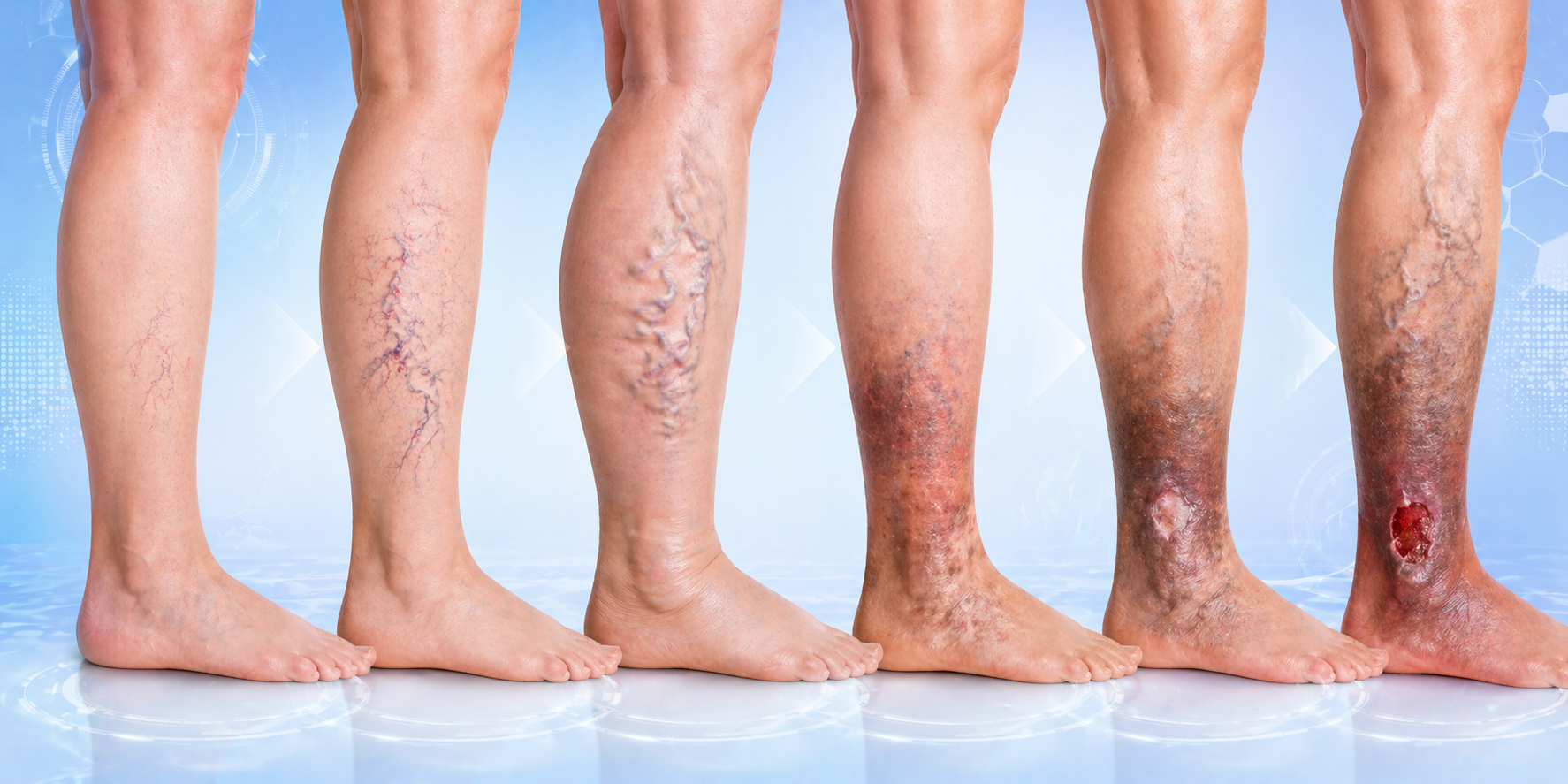
Varicose veins symptoms follow a progression described by the CEAP classification used by vascular surgeons worldwide:
- C1 — Spider veins: Small, thread-like red or purple veins visible near the skin surface. No symptoms — cosmetic only.
- C2 — Varicose veins: Bulging, rope-like veins. May or may not cause symptoms.
- C3 — Oedema (swelling): Ankle and leg swelling by evening that does not fully resolve overnight. Indicates significant venous hypertension.
- C4 — Skin changes: Skin discolouration (brown pigmentation), eczema, or hardening of the skin (lipodermatosclerosis) around the ankle. This indicates long-standing venous insufficiency.
- C5 — Healed venous ulcer: A healed ulcer — strongly associated with underlying varicose vein disease.
- C6 — Active venous ulcer: An open wound near the inner ankle that does not heal — a serious complication of untreated varicose veins. Requires urgent vascular surgery assessment.
Symptoms at all stages include: heaviness and aching in the legs, worse by evening; itching over the veins; cramping at night; and visible swollen, twisted veins. The absence of visible veins does not rule out significant deep venous insufficiency — diagnosis requires a venous duplex ultrasound.
When Do Varicose Veins Need Treatment?
Not all varicose veins require treatment immediately. Treatment is recommended when:
- Symptoms significantly affect quality of life (aching, heaviness, cramps, swelling)
- Skin changes appear (C4) — indicating significant venous hypertension
- A venous ulcer is present or recurrent (C5–C6)
- Bleeding occurs from a superficial varicose vein
- Superficial thrombophlebitis (clot in a varicose vein causing redness and pain) recurs
- The patient wishes treatment for cosmetic reasons (any stage)
Varicose Veins Treatment Options in Delhi NCR
- EVLT (Endovenous Laser Treatment): A laser fibre is inserted into the incompetent saphenous vein under local anaesthesia — the laser closes the vein from inside. No incision, walk-in walk-out procedure, return to work in 1–2 days. The preferred treatment for suitable varicose veins in Delhi NCR.
- RFA (Radiofrequency Ablation): Similar to EVLT but uses radiofrequency energy instead of laser. Equally effective, slightly less post-procedure bruising in some studies.
- Sclerotherapy: A chemical is injected directly into smaller varicose veins and spider veins — causing them to scar and close. Used for C1–C2 disease and residual small veins after EVLT.
- Surgical stripping: The saphenous vein is physically removed through small incisions under general anaesthesia. Effective but involves a longer recovery (2–3 weeks). Reserved for very large veins or when laser/RFA are not feasible.
For a detailed look at EVLT, read our guide on EVLT laser treatment for varicose veins.
Frequently Asked Questions — Varicose Veins Causes Symptoms
What are the main varicose veins causes?
The primary cause of varicose veins is weakened or incompetent one-way valves in the leg veins that allow blood to pool. The most significant risk factors are prolonged standing (occupational), family history, pregnancy, obesity, and increasing age. Women are twice as likely to develop varicose veins as men.
Can varicose veins be dangerous?
Yes — varicose veins can become medically dangerous when they cause skin ulcers (venous ulcers near the ankle), bleeding from a ruptured superficial vein, or when a clot forms (superficial thrombophlebitis). There is also an association between large varicose veins and increased DVT risk. Most cases are managed before these complications develop with appropriate treatment.
Do varicose veins go away without treatment?
No — varicose veins do not resolve on their own once established. Compression stockings reduce symptoms and slow progression, but they do not treat the underlying valve incompetence. The veins will gradually enlarge and symptoms worsen without definitive treatment.
Is varicose vein treatment painful?
Modern EVLT and RFA procedures are performed under local anaesthesia and are well tolerated. Patients walk out of the procedure room and most return to work within 1–2 days. Post-procedure bruising and mild tightness along the treated vein are normal and settle within 2 weeks.
How much does varicose vein treatment cost in Delhi NCR?
EVLT or RFA for varicose veins in Delhi NCR typically costs ₹40,000–₹80,000 per leg depending on the extent of disease and the hospital. Most major health insurance plans cover varicose vein treatment when it is symptomatic and medically indicated — check with your insurer before booking.
Book a varicose vein consultation in Delhi NCR with Dr. Ved Prakash at Yatharth Super Speciality Hospitals, Greater Noida.
Dr. Ved Prakash | Director CTVS — Yatharth Super Speciality Hospitals, Greater Noida
📞 +91-9355255106 |
Book Appointment →