
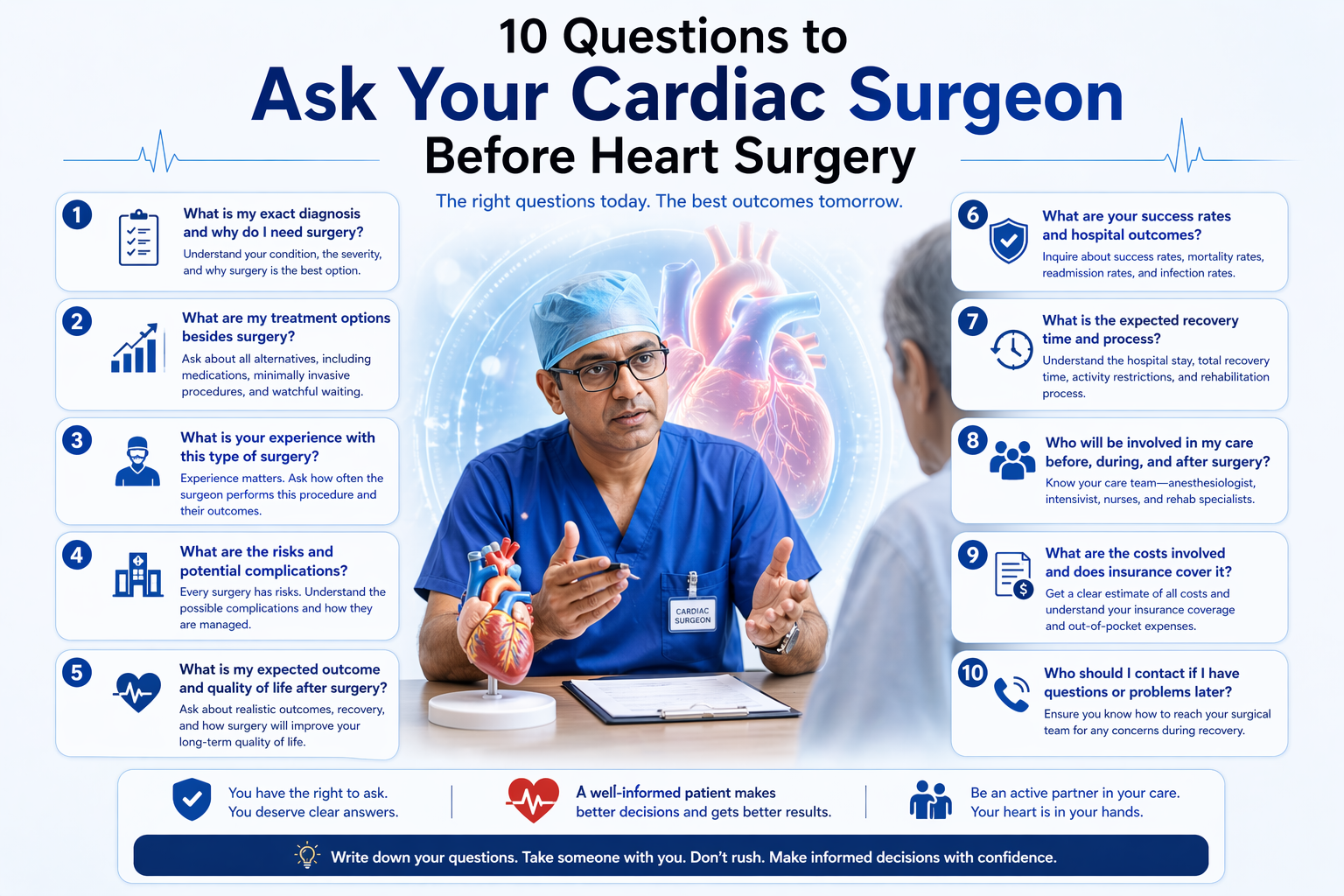
Before agreeing to any heart surgery, every patient has the right — and the responsibility — to ask their cardiac surgeon the right questions. A confident, experienced surgeon welcomes these questions. The answers will tell you a great deal about both the surgeon and whether the recommended surgery is truly in your best interest.
Dr. Ved Prakash, Director of CTVS at Yatharth Super Speciality Hospitals, Greater Noida, has guided hundreds of patients through this process. Here are the 10 most important questions to ask your cardiac surgeon before heart surgery — and what to look for in the answers.
Why Asking Questions Before Heart Surgery Matters
Heart surgery is one of the most significant medical decisions a person can make. It is not reversible once done. The risks, the recovery, the long-term implications — all of these deserve a clear answer before you sign the consent form. The best cardiac surgeons encourage questions. They take time. They do not make you feel rushed.
If a surgeon cannot or will not answer these questions clearly — that itself is important information.
The 10 Questions to Ask Your Cardiac Surgeon
1. “Is surgery definitely necessary for my condition, or are there non-surgical options?”
This is the first and most important question. For some conditions (certain valve diseases, some coronary blockages), medical management or less invasive catheter procedures are valid alternatives. A good surgeon will explain why surgery is recommended over alternatives for your specific anatomy — not give a blanket “you need surgery” without explanation.
2. “What happens if I delay surgery or do not have it at all?”
Understanding the natural history of your condition is essential. Is delaying dangerous? Will the condition worsen significantly in 3–6 months? Or is there a safe window to get a second opinion and reflect? The answer varies dramatically by condition — aortic stenosis with symptoms is urgent; mild mitral regurgitation with no symptoms may be monitored safely for years.
3. “How many times have you performed this specific operation?”
Volume matters in cardiac surgery. A surgeon who performs 50+ bypass surgeries per year has outcomes that are consistently better than one who performs 10. Ask specifically about the operation being recommended for you — not cardiac surgery in general. An experienced surgeon will answer this question directly and with confidence.
4. “What is your personal success rate for this operation?”
Ask for mortality and major complication rates — not just national averages. A senior experienced cardiac surgeon should be able to share their own data. This is not an aggressive question. It is a reasonable one that any ethical surgeon will be comfortable answering.
5. “What are the risks specific to MY case — not just the general risks?”
Generic risk percentages from medical literature do not apply equally to every patient. Your specific risks depend on your age, heart function (ejection fraction), kidney function, diabetes, lung function, and previous operations. Ask your surgeon to apply the risk specifically to your profile — not just read from a standard consent form.
6. “Will you be performing my surgery personally — or will a trainee or fellow?”
In teaching hospitals, it is not uncommon for senior registrars or fellows to perform significant portions of an operation under supervision. You have the right to know this. Ask who specifically will be performing your surgery and what their level of involvement will be. You should feel comfortable with the answer.
7. “What is the recovery timeline and what restrictions will I have?”
Understanding recovery helps you plan practically — for family support, work leave, childcare, and rehabilitation. Ask specifically: How long in hospital? When can I drive? When can I return to work? When can I exercise? When can I travel? A surgeon who cannot answer these clearly has not spent enough time thinking about you as a person.
8. “What medications will I need after surgery and for how long?”
Some medications are lifelong (aspirin, statins after bypass). Mechanical valve recipients need lifelong warfarin with regular blood monitoring. Knowing this in advance helps you plan and avoids surprises at discharge. Ask also about what happens if you miss doses or need to stop a medication before another procedure.
9. “Should I get a second opinion before deciding?”
A confident, ethical cardiac surgeon will answer this question with a clear “yes, if you wish to.” Any surgeon who discourages a second opinion, or who suggests that delaying for a second opinion is dangerous (when clinically it is not), should be approached with caution. A second opinion is your right — and often confirms that surgery is indeed the right decision, giving you much greater peace of mind.
10. “What is the follow-up plan after surgery?”
Cardiac surgery is not a one-time event — it begins a lifelong relationship with cardiac care. Ask: How often will I be seen after surgery? What investigations will be needed (echocardiogram, blood tests)? Who do I contact if I have symptoms after discharge? A surgeon with a clear, structured follow-up plan is one who takes long-term outcomes seriously.
What the Answers Should Tell You
| Good Sign | Warning Sign |
| Takes time to answer each question fully | Rushes you through or seems irritated |
| Quotes their own outcomes data | Gives only general statistics |
| Encourages a second opinion | Discourages second opinion or says “no time” |
| Explains non-surgical alternatives honestly | Presents surgery as the only option without explanation |
| Gives a clear structured recovery timeline | Vague about recovery or restrictions |
When Should You Get a Second Opinion?
Always consider a second opinion when:
- The surgery recommended is major (bypass, valve replacement, aortic surgery)
- You feel uncertain or rushed
- The recommendation conflicts with what another cardiologist said
- The surgeon could not clearly answer questions 1, 3, 4, or 5 above
- You simply want peace of mind before proceeding

A cardiac second opinion in Delhi NCR with Dr. Ved Prakash is available in-person at Yatharth Hospital, Greater Noida — or online via WhatsApp if you are outside Delhi NCR. Share your angiogram, echo, and CT reports in advance and get a clear, independent assessment with no commercial pressure.
Frequently Asked Questions — Questions to Ask Cardiac Surgeon
Is it normal to be nervous about asking a cardiac surgeon questions?
Completely normal — but important to overcome. You are making a major medical decision. A surgeon who makes you feel uncomfortable asking questions is one worth thinking twice about. The best cardiac surgeons welcome informed, engaged patients.
Can I bring a family member to ask questions with me?
Always. Bring your spouse, adult child, or anyone who will support you through the decision. Four ears hear more than two — and family members often ask important questions patients forget in the moment.
Is it too late to get a second opinion after surgery has been recommended?
Never — unless it is a true emergency. For all elective or semi-urgent cardiac surgery, a second opinion takes days at most and can profoundly affect your confidence in the decision. An online cardiac consultation in India with Dr. Ved Prakash can often be arranged within 24–48 hours of sharing reports.
You Deserve a Surgeon Who Answers Every Question
At Yatharth Super Speciality Hospitals, Greater Noida, Dr. Ved Prakash takes the time to answer every question before any cardiac surgery recommendation. Families are always welcome. No patient is rushed into a decision.
Dr. Ved Prakash | Director CTVS — Yatharth Super Speciality Hospitals, Greater Noida
📞 +91-9355255106 |
Book Appointment →