
Aortic Valve Replacement Without Opening the Chest: TAVI — Transcatheter Aortic Valve Implantation — is a procedure that replaces a diseased aortic heart valve through a catheter passed through the leg artery, without any chest incision and without stopping the heart. For the millions of elderly patients in India who have been told their aortic valve is severely narrowed but that open surgery is too risky at their age, TAVI is often the answer. Dr. Ved Prakash, Director of CTVS at Yatharth Super Speciality Hospitals, Greater Noida, explains what TAVI is, how the procedure works, and crucially, how the decision between TAVI and open surgery is made.
Why Was TAVI Developed?
Aortic stenosis — narrowing of the aortic valve — is the most common serious valve disease in patients over 65. Once symptoms appear, the average untreated survival is 1–3 years. For decades, the only treatment was open surgical valve replacement, which carries significant risk in frail, elderly, or medically complex patients. The TAVI procedure was developed specifically to treat this group — offering a life-saving valve replacement without the trauma of open surgery. First performed in humans in 2002, TAVI has now been performed on over a million patients worldwide with results that equal or exceed open surgery in high-risk groups.
What Is Aortic Stenosis — the Condition TAVI Treats?
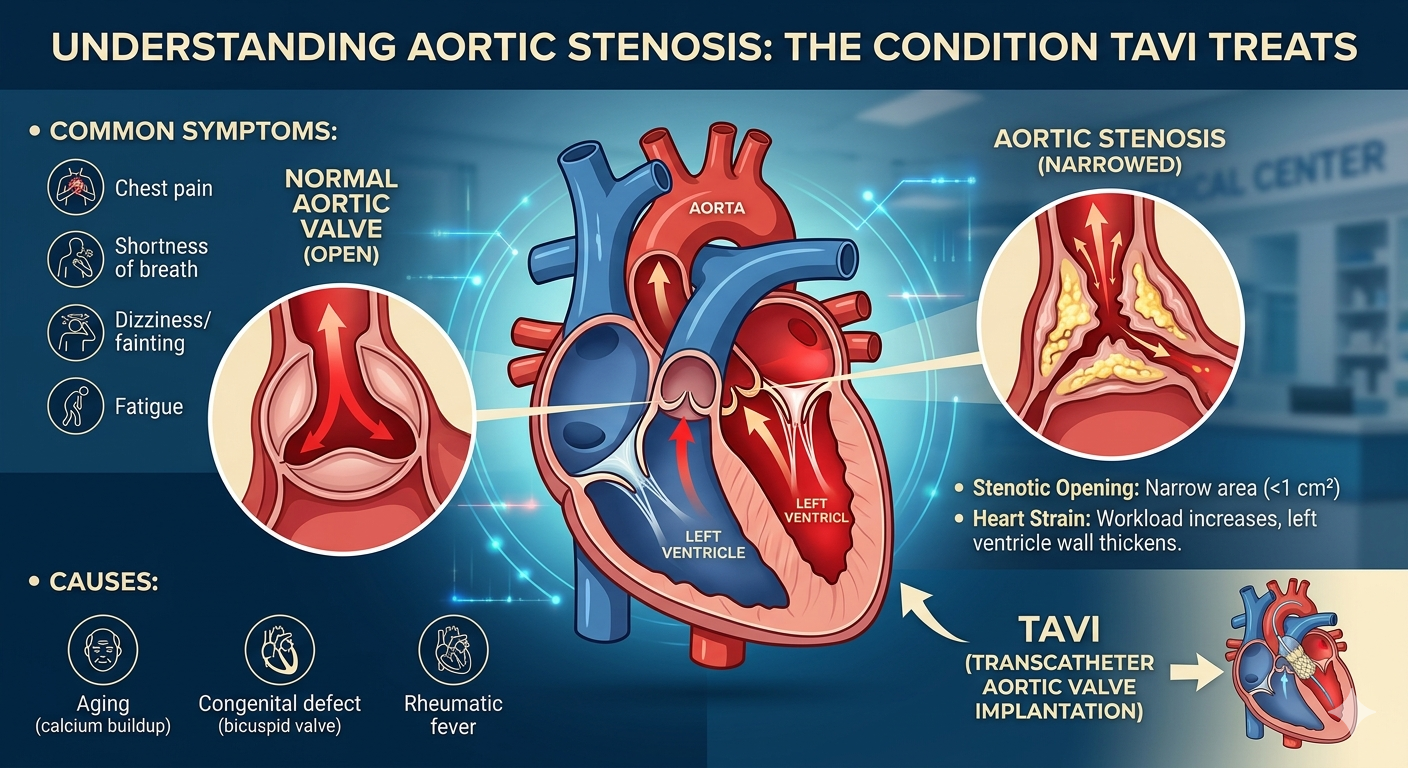
The aortic valve sits between the left ventricle and the aorta, controlling blood flow from the heart to the rest of the body. In aortic stenosis, the valve leaflets thicken, stiffen, and calcify over years — narrowing the valve opening until blood can no longer flow freely. The heart works harder to push blood through the narrowed valve, eventually leading to heart failure. Symptoms include breathlessness on exertion, chest pain, and blackouts (syncope). Once any of these symptoms appear, urgent treatment is needed.
What Is TAVI — How the Procedure Works
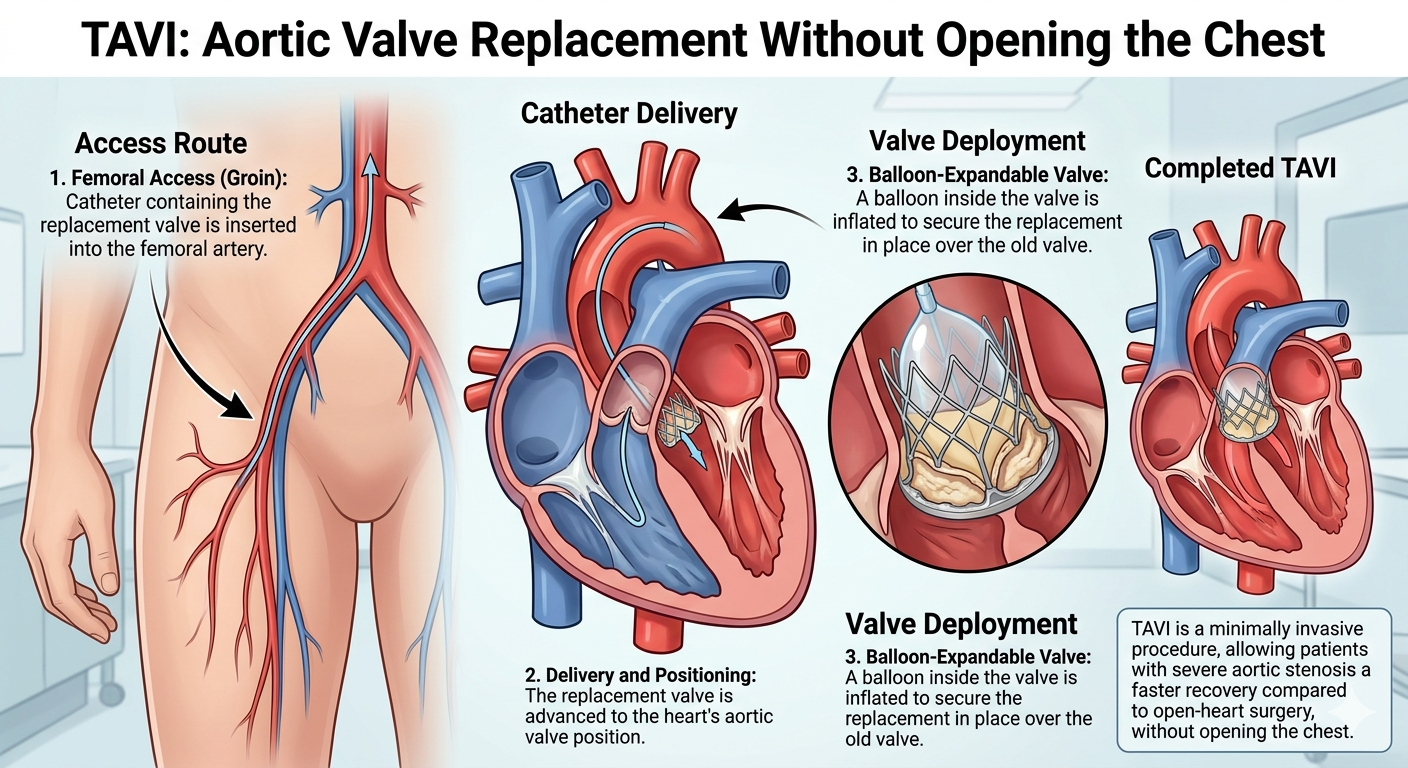
The TAVI procedure delivers a replacement biological tissue valve to the heart entirely through blood vessels — most commonly the femoral artery in the groin. Here is what happens:
Transfemoral Access
A small puncture is made in the femoral artery in the groin. No chest incision. A guidewire is advanced through the artery, up the aorta, and across the diseased aortic valve under continuous X-ray guidance.
Valve Delivery
The replacement valve — compressed onto a small expandable frame — is loaded onto a catheter and advanced over the guidewire to the level of the native aortic valve. Precise positioning is confirmed using simultaneous echocardiography and fluoroscopy.
Valve Deployment
The new valve is expanded — either by balloon inflation or by self-expansion depending on the valve type. It immediately opens and begins functioning, pushing the old calcified leaflets aside. The left ventricle now pumps blood freely through the new valve.
Confirmation and Closure
Echocardiography and angiography confirm the valve is working correctly and there is no significant leakage. The groin access site is closed with a vascular closure device — no surgical cut-down needed in most cases. Total procedure time: 1–2 hours.
How Is the Decision Made — TAVI or Open Surgery?
This is the question every patient and family deserves a clear answer to. At Yatharth Hospital, this decision is never made by one doctor alone — it is made by a Heart Team consisting of Dr. Ved Prakash (cardiac surgeon), an interventional cardiologist, and a cardiac anaesthetist, who review the echocardiogram, CT angiography, and clinical status together.
| Factor | Favours TAVI | Favours Open Surgery (SAVR) |
| Age | Over 75 | Under 65–70 |
| Surgical risk score | High or intermediate | Low |
| Lung function | Poor (COPD) | Normal |
| Aortic calcification | Severe (avoids clamping) | Minimal |
| Need for bypass surgery simultaneously | No | Yes — open surgery required |
| Valve durability need | Shorter life expectancy | Young patient needing 20+ years |
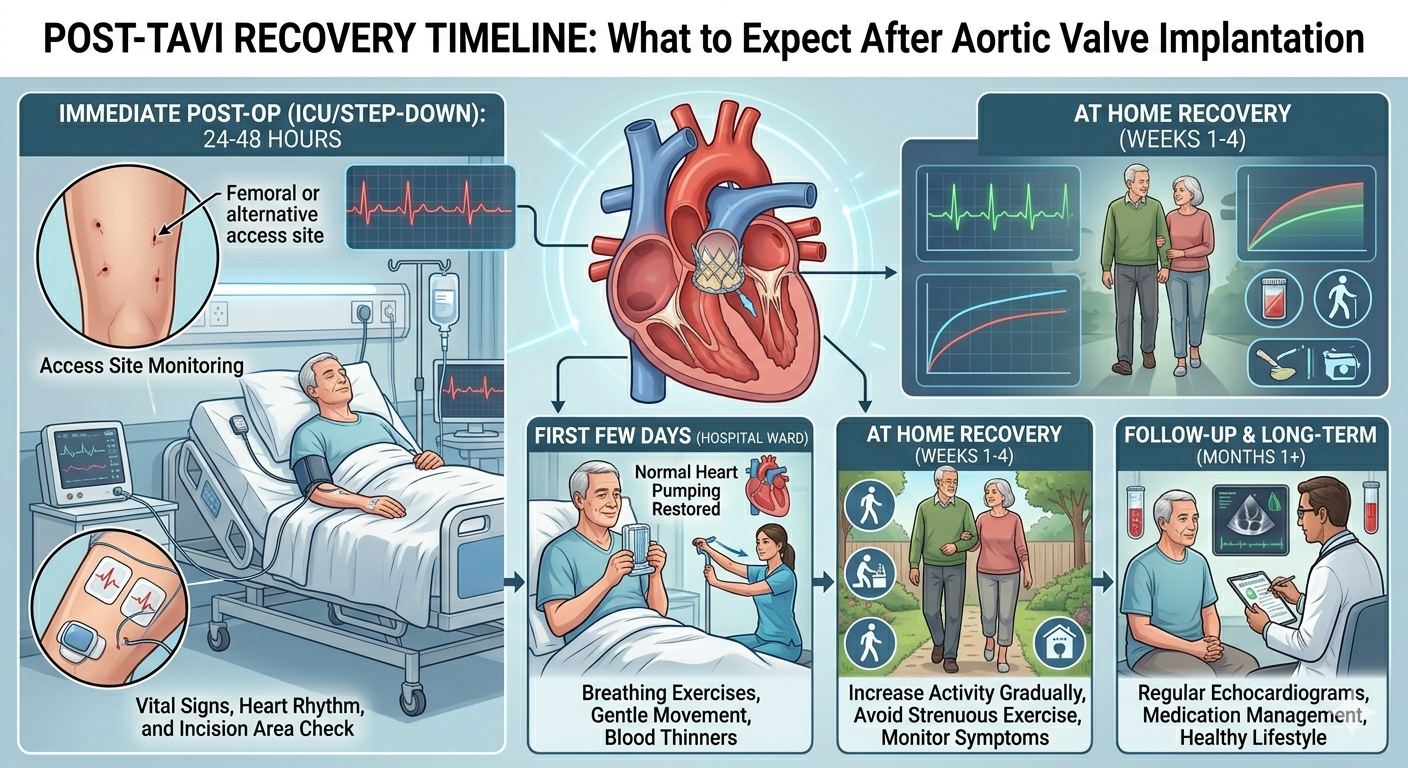
What to Expect After TAVI
- Hospital stay: 3–5 days in most patients — compared to 7–10 days after open surgery
- Walking: The following day after TAVI in most cases
- Breathlessness: Most patients notice dramatic improvement within days as the heart begins pumping freely through the new valve
- Pacemaker risk: Approximately 10–15% of patients require a permanent pacemaker — this is discussed before every procedure
- Medications: Aspirin lifelong. Clopidogrel for 3–6 months. No warfarin required unless the patient has atrial fibrillation.
- Follow-up: Echocardiogram at 1 month, 1 year, then annually to monitor valve function
- TAVI valve lifespan: 10–15 years in most patients. A second TAVI (valve-in-valve) can often be performed if the first valve eventually wears out.
For patients in Delhi NCR and surrounding areas, TAVI at Yatharth Hospital is performed by Dr. Ved Prakash with a dedicated Heart Team and full cath lab and hybrid OT capability. For more on heart valve surgery options including both TAVI and open procedures, visit the heart valve surgery page.
Key Aspects of TAVI / TAVR (Explained Simply)
1. Procedure
TAVI (or TAVR) is a minimally invasive heart procedure.
Instead of opening the chest like traditional open-heart surgery, doctors make a small puncture (about 1 cm) usually in the groin artery. A thin tube called a catheter is gently guided through the blood vessels to reach the heart.
2. Valve Replacement
A new artificial valve, folded inside the catheter, is delivered to the damaged aortic valve.
Once in position, the new valve expands and pushes the old valve aside, immediately allowing blood to flow normally again.
3. Who Needs TAVI?
TAVI mainly treats severe aortic stenosis, a condition where the heart valve becomes narrow or stiff and blocks blood flow.
It can be suitable for patients who are high-risk, intermediate-risk, or even low-risk for traditional open-heart surgery, depending on medical evaluation.
4. Benefits of TAVI
- No large chest incision
- Shorter hospital stay (usually 2–3 days)
- Less pain and faster recovery
- Earlier return to normal daily activities
5. Possible Risks
Like any medical procedure, TAVI has some risks, although it is safe for most patients:
- Bleeding or infection
- Stroke (rare)
- Heart rhythm problems
- Small leak around the new valve
Frequently Asked Questions — What Is TAVI Procedure
What is TAVI and how is it different from open heart valve surgery?
TAVI replaces the aortic valve through a catheter in the groin — no chest incision, no stopping of the heart. Open surgery (SAVR) requires a chest incision and heart-lung machine. TAVI is recommended for high-risk, frail, or elderly patients. Both achieve the same goal — a functioning aortic valve.
Who is a candidate for TAVI?
Patients with severe symptomatic aortic stenosis who are at high or intermediate surgical risk. Current ESC 2024 guidelines recommend TAVI as first-choice for all patients over 75, regardless of surgical risk. Each patient is assessed individually by a Heart Team.
Does TAVI require lifelong blood thinners?
No warfarin required — unlike mechanical valves. Aspirin lifelong. Clopidogrel for 3–6 months post-procedure. If the patient also has atrial fibrillation, anticoagulation is managed separately.
What is the risk of needing a pacemaker after TAVI?
Approximately 10–15%. The new valve can interfere with the heart’s conduction system at the level of the AV node. This risk is discussed with every patient before the procedure and factored into the Heart Team’s recommendation.
Dr. Ved Prakash | Director, CTVS — Yatharth Super Speciality Hospitals, Greater Noida
📞 +91-9355255106 |
📧 drvedprakash@gmail.com |
Book Appointment →