

Your angiography report shows blockages and you are sitting in the hospital being told you need either a stent or bypass surgery — possibly within the next few hours. This is one of the most high-pressure, high-stakes moments a cardiac patient faces. Dr. Ved Prakash, Director of CTVS at Yatharth Super Speciality Hospitals, Greater Noida, explains exactly how the bypass surgery vs stent decision is made — what factors determine which treatment is right for your specific angiogram.
First — You Do Not Have to Decide This Minute
Unless you are having a heart attack right now (STEMI — ST elevation on your ECG, complete artery blockage), you are not in an emergency situation that requires an immediate decision on the table. For stable or planned angiography findings, you have time — hours or days at minimum — to understand your options, ask the right questions, and if needed, get a second opinion. You are never obligated to accept stenting on the same day as your diagnostic angiography.
The Key Questions Your Angiogram Must Answer First
Before anyone can tell you whether stent or bypass is right, the following must be clearly established from your angiogram:
- How many arteries are blocked? (one, two, or all three)
- Which arteries? (LAD, LCx, RCA — or left main?)
- How severe is each blockage? (percentage stenosis)
- What is the SYNTAX score? (a complexity score calculated from the angiogram)
- What is your ejection fraction? (from your echocardiogram)
- Do you have diabetes?
The answer to these six questions determines the treatment recommendation — not individual preference, not which doctor you see first, and not which speciality the treating team belongs to.
The Decision Framework — Based on Your Angiogram
| What Your Angiogram Shows | Stent (PCI) | Bypass Surgery (CABG) |
| Single vessel, non-diabetic, simple lesion | Usually appropriate | Rarely needed |
| Single vessel, LAD proximal, complex lesion | Possible if technically suitable | LIMA-LAD graft often preferred long-term |
| Two vessel, non-diabetic, low SYNTAX | May be appropriate | Heart Team decision |
| Two vessel, diabetic | Higher restenosis risk | Often preferred |
| Three vessel disease, any patient | High restenosis, more re-procedures | Strongly preferred |
| Three vessel disease + diabetes | Significantly inferior outcomes (FREEDOM trial) | Guideline recommendation |
| Left main disease, any patient | Only in selected low-risk anatomy | Recommended in most cases |
| Any + EF below 35% | Incomplete revascularisation likely | Survival benefit established |
What the SYNTAX Score Tells You
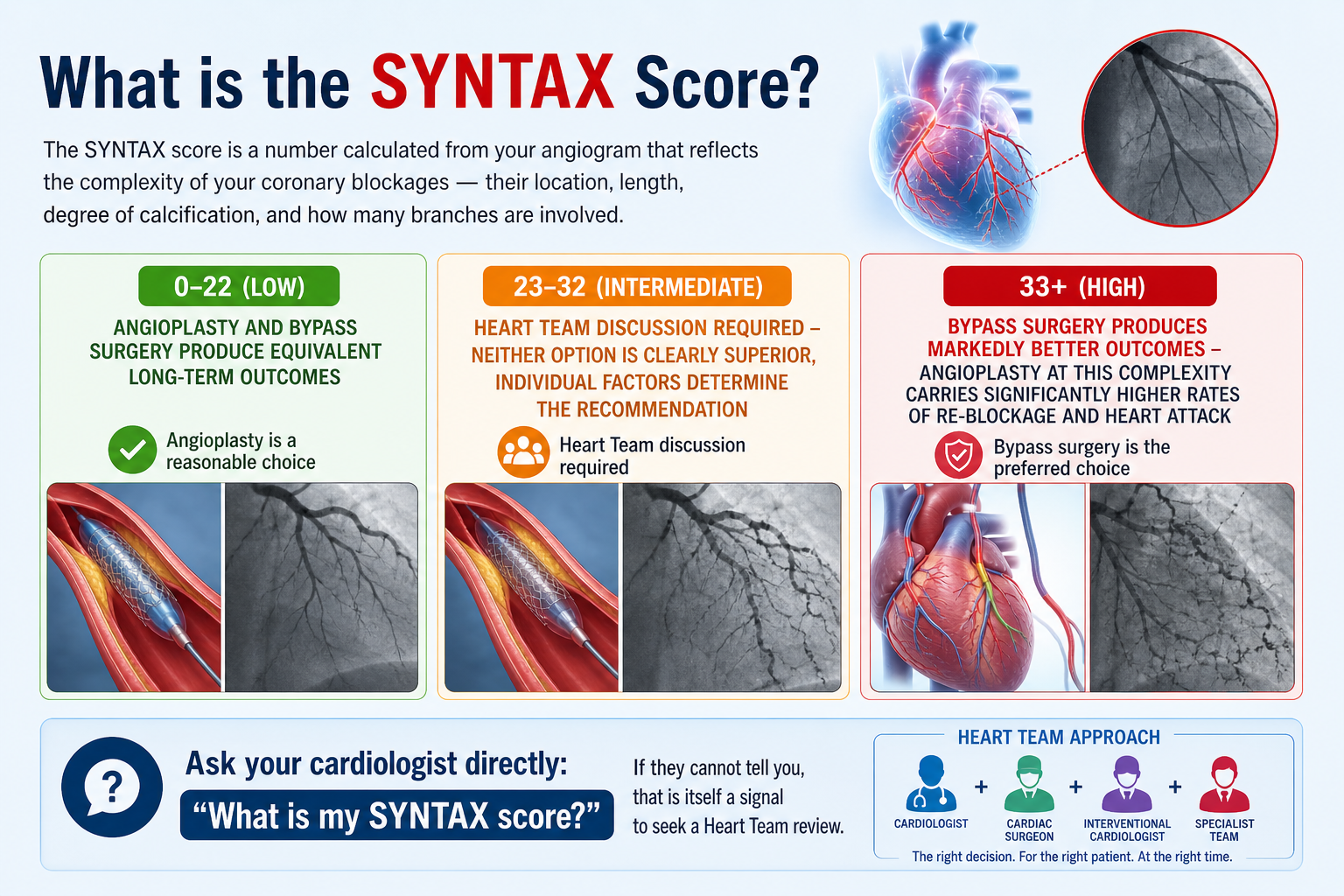
If your cardiologist or cardiac surgeon mentions the SYNTAX score, this is what it means. The SYNTAX score is a number calculated from your angiogram that reflects the complexity of your coronary blockages — their location, length, degree of calcification, and how many branches are involved.
- SYNTAX score 0–22 (low): Angioplasty and bypass surgery produce equivalent long-term outcomes — angioplasty is a reasonable choice
- SYNTAX score 23–32 (intermediate): Heart Team discussion required — neither option is clearly superior, individual factors determine the recommendation
- SYNTAX score 33+ (high): Bypass surgery produces markedly better outcomes — angioplasty at this complexity carries significantly higher rates of re-blockage and heart attack
Ask your cardiologist directly: “What is my SYNTAX score?” If they cannot tell you, that is itself a signal to seek a Heart Team review.
Why You Should Always Hear From a Cardiac Surgeon Before Deciding
In India, most cardiac catheterisation labs are run by interventional cardiologists — who perform angioplasty but not bypass surgery. This creates a structural situation where the doctor recommending your treatment is only able to offer one of the two options. This is not a criticism — it is simply the reality of subspecialty medicine. The solution is the Heart Team model: a cardiologist and a cardiac surgeon review the same angiogram together and jointly recommend treatment.
If you have multi-vessel disease and you have been offered angioplasty by an interventional cardiologist without any cardiac surgeon’s input, you are entitled — and advised — to get a cardiac second opinion from a CTVS surgeon who reviews your angiogram independently. Share your angiogram CD via WhatsApp to +91-9355255106 for Dr. Ved Prakash’s assessment before making any decision.
What to Ask Before Accepting a Stent for Multi-Vessel Disease
- “What is my SYNTAX score?”
- “Has a cardiac surgeon reviewed my angiogram alongside you?”
- “Am I diabetic — and if so, has that been factored into this recommendation?”
- “What is the risk that this stent will need to be redone in 5 years?”
- “Is my LAD being stented — and is a LIMA bypass graft not being considered?”
You can read more about understanding your angiography report and what the blockage percentages mean.
Frequently Asked Questions — Angiography Shows Blockage Bypass or Stent
My angiography shows one blockage — do I need bypass or a stent?
For a single blockage in a non-diabetic patient with a technically suitable lesion, a stent is usually appropriate and sufficient. Bypass for single vessel disease is reserved for specific situations — proximal LAD disease or lesions not suitable for catheter-based treatment.
My angiography shows three vessel disease — is bypass surgery mandatory?
For most patients — especially diabetics and those with a high SYNTAX score — bypass surgery is the guideline-recommended treatment. The SYNTAX and FREEDOM trials confirm significantly better long-term outcomes versus stenting in triple vessel disease.
Can I refuse bypass surgery and choose a stent instead?
Yes — patients always have the right to decide. But for multi-vessel disease where bypass is guideline-recommended, choosing angioplasty carries a meaningfully higher risk of repeat procedures, heart attack, and long-term mortality. Get both a cardiologist’s and cardiac surgeon’s opinion before deciding.
Do I have to decide immediately after angiography?
No — for non-emergency stable findings, you have time to understand your options and seek a second opinion. Only an acute STEMI (complete blockage, active heart attack) requires immediate treatment without delay.
Dr. Ved Prakash | Director, CTVS — Yatharth Super Speciality Hospitals, Greater Noida
📞 +91-9355255106 |
📧 drvedprakash@gmail.com |
Book Appointment →
323222