
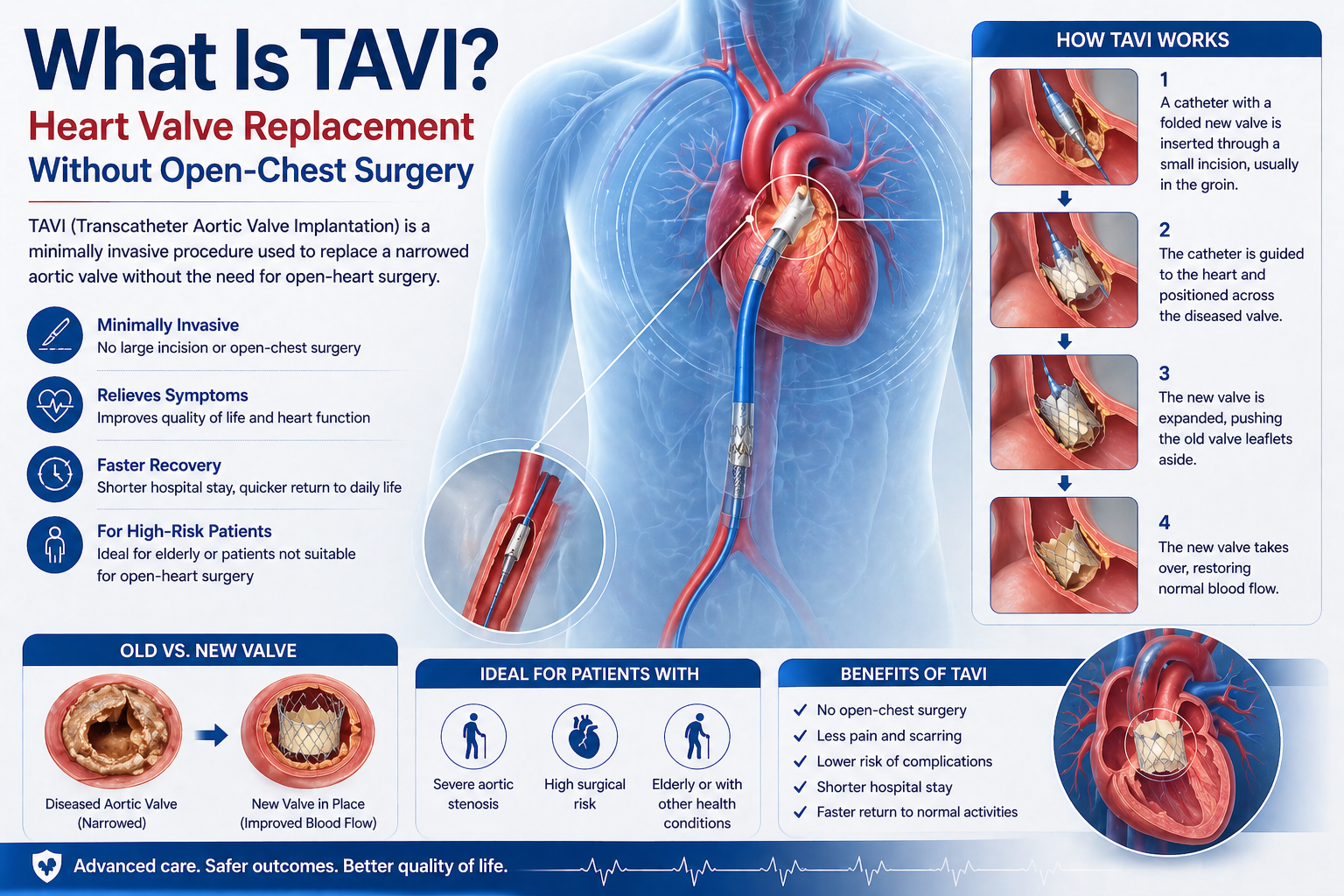
TAVI — Transcatheter Aortic Valve Implantation — is a procedure that replaces the aortic heart valve through a catheter inserted through the leg artery, without opening the chest at all. It has transformed cardiac care for thousands of patients who were previously told they were too old or too unwell for heart surgery. Dr. Ved Prakash, Director of CTVS at Yatharth Super Speciality Hospitals, Greater Noida, explains the TAVI procedure, who qualifies, and how the decision between TAVI and open surgery is made.
What Is TAVI — The Basics
TAVI (also called TAVR — Transcatheter Aortic Valve Replacement) is a catheter-based procedure that delivers a replacement aortic valve to the heart through an artery in the groin (femoral artery) — or sometimes through the chest wall (transapical) — without making a large chest incision or stopping the heart.
The new biological tissue valve is compressed onto a small expandable frame and mounted on a catheter. Once positioned precisely inside the diseased native aortic valve using X-ray and echocardiographic guidance, the new valve is deployed — opening like a flower and immediately taking over the function of the diseased valve. The old, calcified valve leaflets are pushed aside. The procedure takes 1–2 hours. Most patients walk the next day and go home within 3–5 days.
Why Was the TAVI Procedure Developed?
Aortic stenosis — the narrowing of the aortic valve — is the most common serious valve disease in patients over 65. Untreated severe aortic stenosis carries an average survival of 1–3 years once symptoms appear. For decades, the only treatment was open-heart surgical valve replacement (SAVR) — which in elderly or medically frail patients carries significant risk.
The TAVI procedure was developed specifically to offer these high-risk patients a life-saving valve replacement without the trauma of open surgery. First performed in 2002, TAVI has now been performed on over 1 million patients worldwide — with outcomes equivalent to surgery in high and intermediate-risk patients, and now expanding to low-risk patients as well.
Who Is a Candidate for the TAVI Procedure?
The TAVI procedure is recommended for patients with:
- Severe symptomatic aortic stenosis — confirmed on echocardiogram (valve area <1.0 cm², mean gradient >40 mmHg) AND symptoms of breathlessness, chest pain, or syncope
- High or intermediate surgical risk — assessed using the STS Score or EuroSCORE II (heart surgery risk calculators)
- Suitable aortic valve anatomy and femoral artery access — confirmed by CT angiography before the TAVI procedure
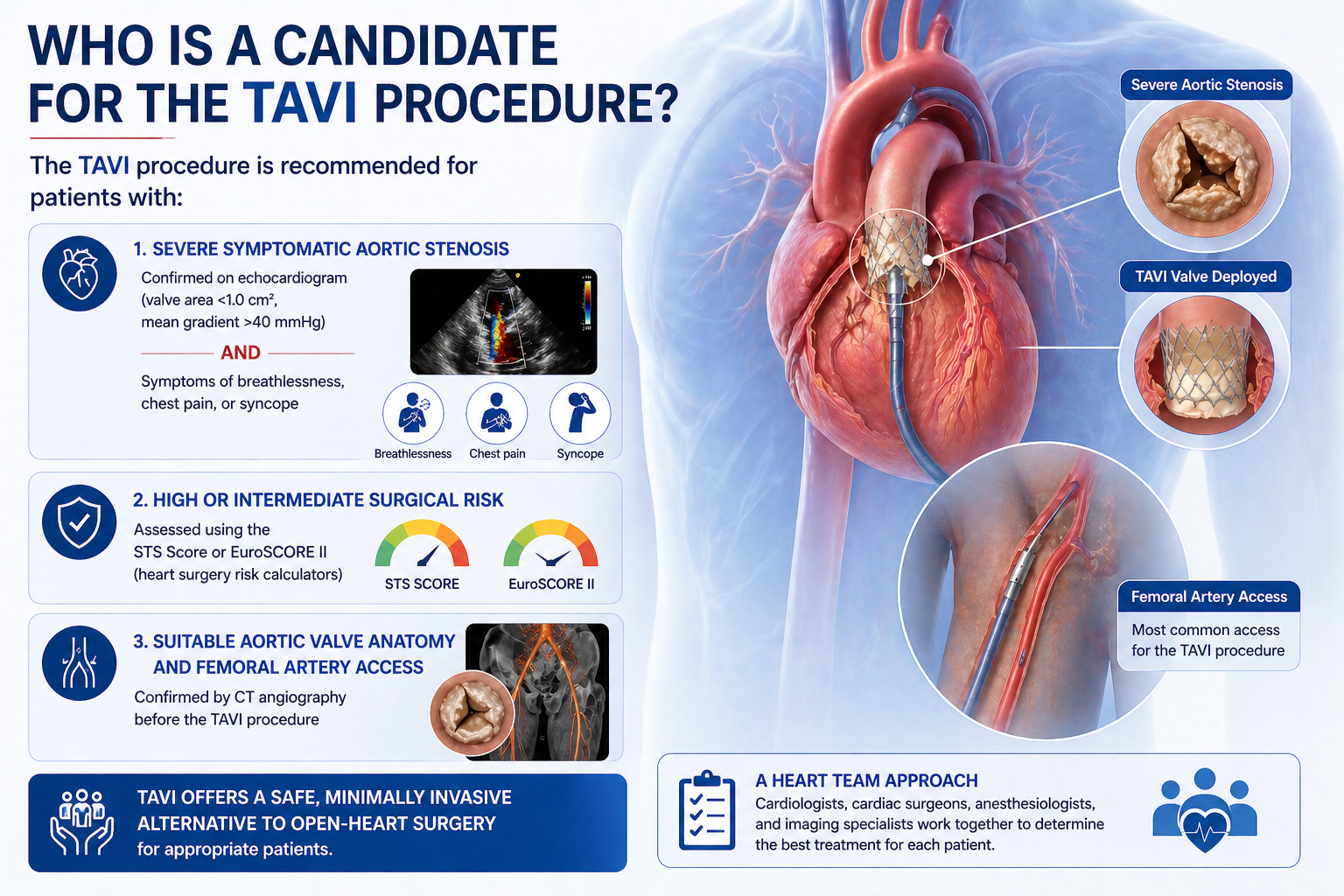
The TAVI procedure is also being used increasingly in lower-risk patients — and as of the most recent ESC/ACC guidelines (2024), TAVI is a Class I recommendation across all risk groups for severe symptomatic aortic stenosis in patients over 75.
TAVI vs Open Heart Surgery (SAVR) — How Is the Decision Made?
This is where the Heart Team concept is essential — and where most TAVI articles fail patients by not explaining it.
Every patient considered for aortic valve replacement at Yatharth Hospital is evaluated by a Heart Team — consisting of Dr. Ved Prakash (cardiac surgeon) + an interventional cardiologist + an anaesthetist — who review the echocardiogram, CT angiography, and clinical status together before recommending TAVI or surgery.
| Factor | Favour TAVI | Favour Open Surgery (SAVR) |
| Age | Over 75 years | Under 65–70 years |
| Surgical risk | High or intermediate | Low (young, fit patient) |
| Lung function | Poor (COPD, pulmonary fibrosis) | Normal |
| Aortic calcification | Severe (avoids aortic clamping) | Minimal |
| Need for simultaneous procedures | No — valve only | Yes — coronary bypass + valve |
| Valve durability need | Less critical (older patient) | Long term (younger patient) |
What Happens During the TAVI Procedure — Step by Step
- Anaesthesia: General anaesthesia or conscious sedation (local anaesthesia + sedation) — depending on the patient and the centre’s protocol
- Access: A small puncture in the femoral artery in the groin. No chest incision in transfemoral TAVI.
- Crossing the valve: A guidewire is advanced through the femoral artery, up the aorta, and across the diseased aortic valve — guided by X-ray
- Balloon valvuloplasty: A small balloon briefly opens the calcified valve to create space for the new valve
- Valve deployment: The replacement valve on its delivery system is positioned precisely at the level of the native aortic valve — then deployed. The valve immediately starts functioning.
- Confirmation: Echocardiography and angiography confirm the valve is working correctly, there is no significant leakage, and the coronary arteries remain open
- Access closure: The femoral artery puncture is closed with a vascular closure device — no surgical cut-down needed in most cases
Life After the TAVI Procedure — What to Expect
- Hospital stay: 3–5 days in most patients — significantly shorter than the 7–10 days after open surgery
- Walking: The next day after the TAVI procedure in most cases
- Medications after TAVI: Aspirin lifelong (to prevent clotting on the new valve) + clopidogrel for 3–6 months. Warfarin is generally NOT required after TAVI unless you also have atrial fibrillation.
- Pacemaker: Approximately 10–15% of TAVI patients require a permanent pacemaker — the new valve can sometimes interfere with the heart’s electrical conduction system. This is discussed with every patient before the TAVI procedure.
- Echocardiogram follow-up: At 1 month, 1 year, and annually thereafter — to check valve function and detect any late complications
- TAVI valve lifespan: 10–15 years in most patients. If a TAVI valve wears out, a second TAVI (valve-in-valve) can often be performed.
Frequently Asked Questions — What Is TAVI Procedure
What is the TAVI procedure and is it major surgery?
The TAVI procedure is a minimally invasive catheter-based aortic valve replacement — not open-heart surgery. No chest incision is made, the heart is not stopped, and no heart-lung machine is used. Most patients are discharged in 3–5 days and return to full activity within 2–4 weeks.
Is TAVI safe for elderly patients?
Yes — TAVI was specifically developed for high-risk and elderly patients who cannot safely undergo open surgery. In patients over 80 with severe aortic stenosis and multiple comorbidities, the TAVI procedure offers a survival benefit and quality-of-life improvement that would not be achievable with open surgery.
What is the success rate of the TAVI procedure in India?
At experienced TAVI centres in India, procedural success rates exceed 95–97%. Yatharth Super Speciality Hospitals, Greater Noida performs TAVI procedures with a dedicated Heart Team and state-of-the-art hybrid cath lab and echo guidance.
Does the TAVI procedure require blood thinners for life?
No — unlike mechanical valve replacement, TAVI does not require lifelong warfarin. Aspirin is continued lifelong. Clopidogrel is typically prescribed for 3–6 months after the TAVI procedure. If the patient also has atrial fibrillation, anticoagulation management is individualised.
How much does the TAVI procedure cost in Delhi NCR?
The TAVI procedure in Delhi NCR typically costs ₹8–15 lakhs depending on the valve type used and the hospital. Most major insurance companies and Ayushman Bharat cover TAVI for eligible patients — check your policy for pre-authorisation requirements and the empanelled hospital list.
Book a TAVI procedure assessment in Delhi NCR at Yatharth Super Speciality Hospitals, Greater Noida. Share your echocardiogram and CT report via WhatsApp for a pre-assessment before your in-person Heart Team consultation.
Dr. Ved Prakash | Director CTVS — Yatharth Super Speciality Hospitals, Greater Noida
📞 +91-9355255106 |
Book Appointment →