
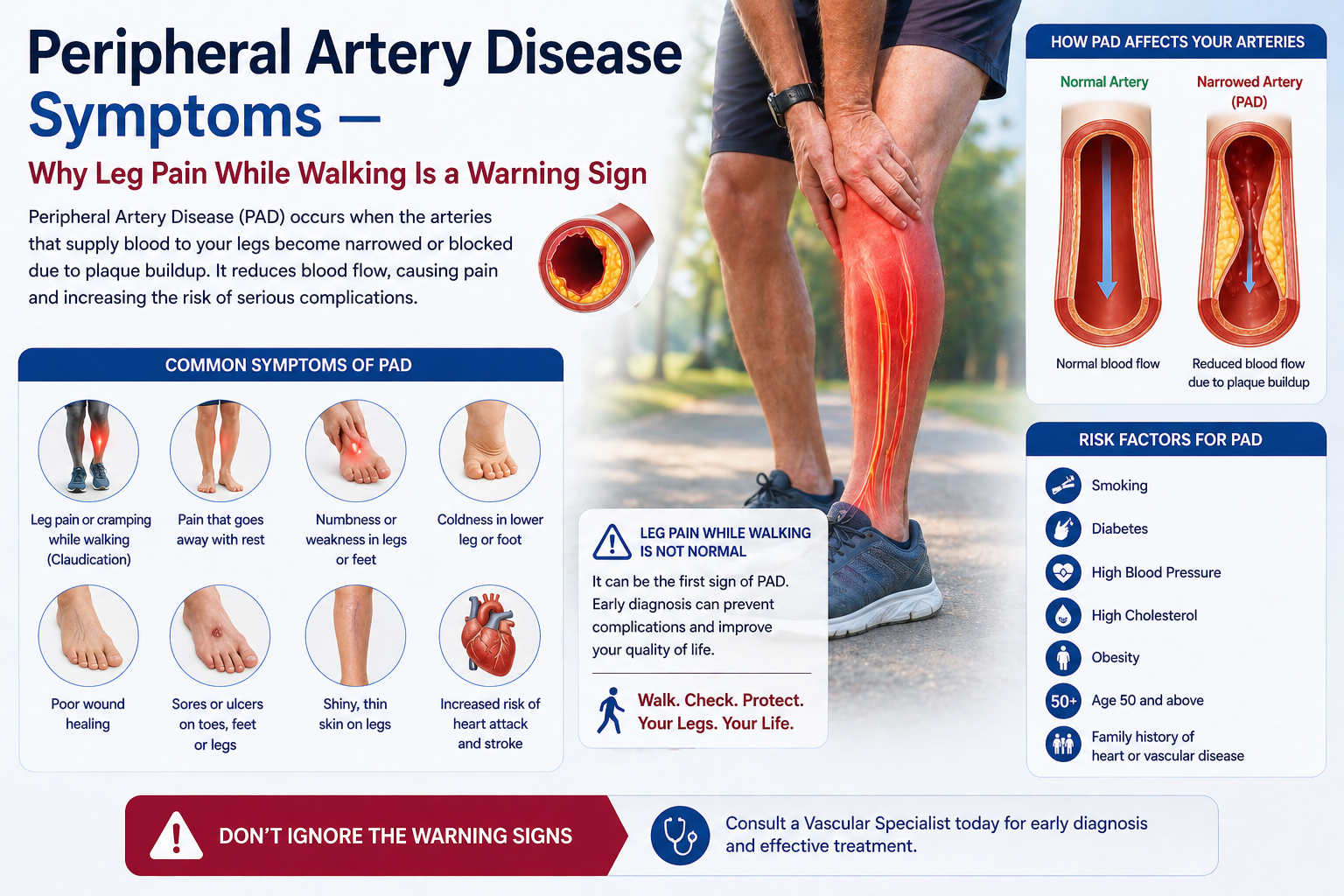
Peripheral artery disease symptoms are one of the most under-recognised warning signs in Indian medicine — and in diabetic patients, peripheral artery disease symptoms are particularly dangerous because they are often absent entirely until the disease is advanced. Dr. Ved Prakash, Director of CTVS and Vascular Surgery at Yatharth Super Speciality Hospitals, Greater Noida, explains peripheral artery disease symptoms, causes, risk groups, and when surgery or endovascular treatment is needed in Delhi NCR.
What Is Peripheral Artery Disease?
Peripheral artery disease (PAD) is atherosclerosis of the arteries supplying the legs — the same process of plaque buildup that causes coronary artery disease in the heart, but affecting the vessels below the waist. As plaque builds up, the leg arteries narrow — reducing blood supply to the muscles and tissues of the leg. The result is the characteristic peripheral artery disease symptom of claudication: leg pain or cramping that comes on with walking and is relieved within 5 minutes of rest.
Peripheral artery disease affects approximately 200 million people worldwide and is significantly underdiagnosed in India — particularly in patients with diabetes, where the classic peripheral artery disease symptoms may be absent due to accompanying nerve damage (neuropathy).
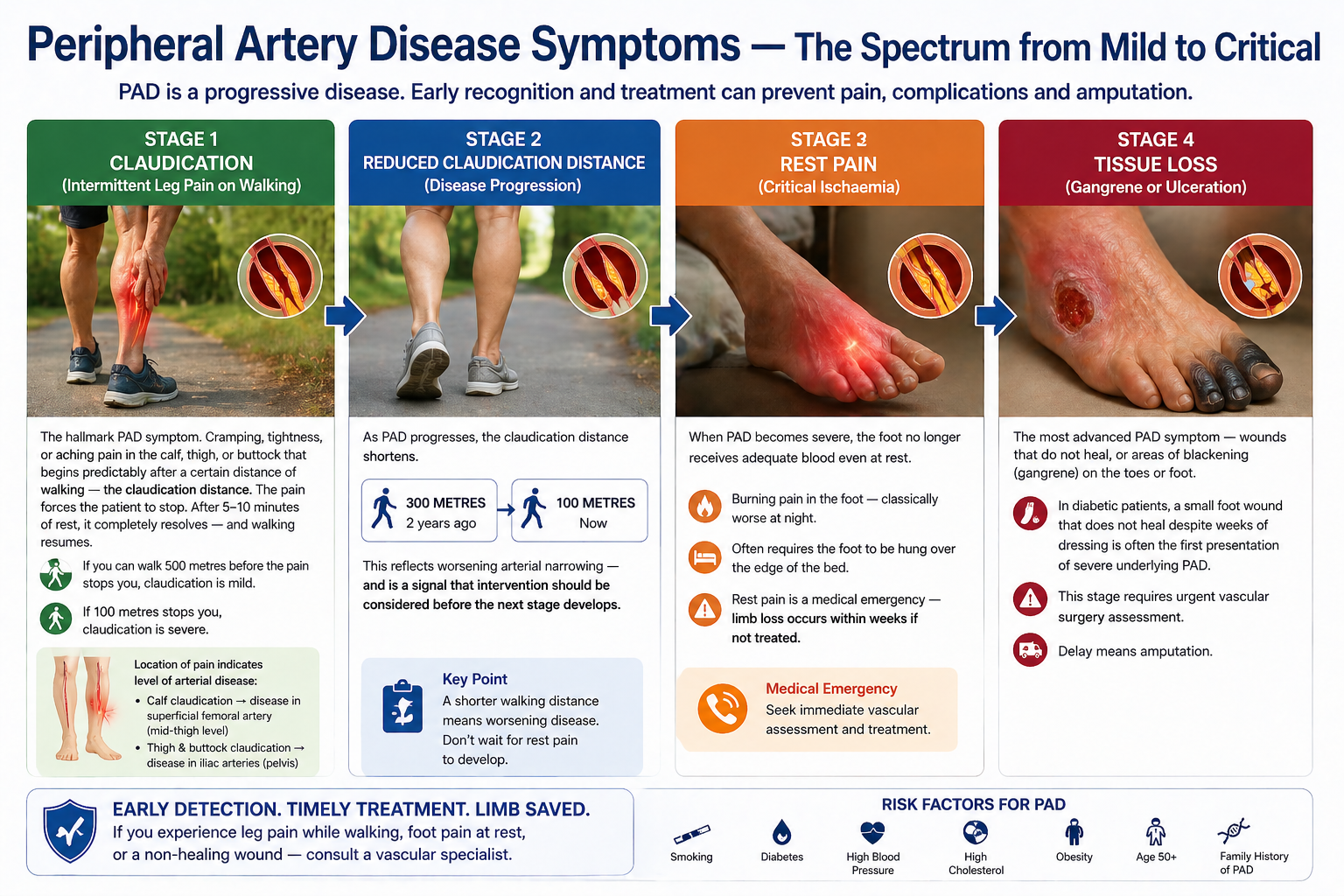
Peripheral Artery Disease Symptoms — The Spectrum from Mild to Critical
Stage 1 — Claudication (Intermittent Leg Pain on Walking)
The hallmark peripheral artery disease symptom. Cramping, tightness, or aching pain in the calf, thigh, or buttock that begins predictably after a certain distance of walking — the claudication distance. The pain forces the patient to stop. After 5–10 minutes of rest, it completely resolves — and walking resumes. If you can walk 500 metres before the pain stops you, claudication is mild. If 100 metres stops you, claudication is severe.
The location of the pain indicates the level of arterial disease: calf claudication means disease in the superficial femoral artery (mid-thigh level); thigh and buttock claudication indicates disease higher up, in the iliac arteries of the pelvis.
Stage 2 — Reduced Claudication Distance (Disease Progression)
As peripheral artery disease progresses, the claudication distance shortens. A patient who could walk 300 metres 2 years ago can now manage only 100 metres. This reflects worsening arterial narrowing — and is a signal that intervention should be considered before the next stage develops.
Stage 3 — Rest Pain (Critical Ischaemia)
When peripheral artery disease becomes severe enough, the foot no longer receives adequate blood even at rest. The patient experiences burning pain in the foot — classically worse at night, often requiring the foot to be hung over the edge of the bed (which uses gravity to increase blood flow). Rest pain is a medical emergency — limb loss occurs within weeks if not treated.
Stage 4 — Tissue Loss (Gangrene or Ulceration)
The most advanced peripheral artery disease symptom — wounds that do not heal, or areas of blackening (gangrene) on the toes or foot. In diabetic patients, a small foot wound that does not heal despite weeks of dressing is often the first presentation of severe underlying PAD. This stage requires urgent vascular surgery assessment — delay means amputation.
Peripheral Artery Disease Symptoms in Diabetic Patients — The Silent Crisis
Diabetic neuropathy damages the peripheral nerves — meaning diabetic patients with severe PAD may have no pain at all. They do not experience claudication, no rest pain, and they may not feel a wound developing on their foot. The first sign of advanced peripheral artery disease in a diabetic patient is often a non-healing ulcer or blackened toe — by which time the disease is already critical.
All diabetic patients over 50 should have an annual ABI (Ankle-Brachial Index) measurement — a simple, painless test that compares blood pressure in the ankle to the arm to screen for peripheral artery disease silently.
What Causes Peripheral Artery Disease?
Peripheral artery disease is caused by atherosclerosis — the same risk factors as heart disease:
- Smoking: The single strongest modifiable risk factor for PAD — smokers have 3–5 times the peripheral artery disease risk of non-smokers. Stopping smoking slows PAD progression significantly.
- Diabetes: Doubles PAD risk and dramatically worsens outcomes — particularly for below-knee arterial disease
- Hypertension (high blood pressure)
- High cholesterol (hyperlipidaemia)
- Family history of vascular disease
- Obesity and sedentary lifestyle
How Is Peripheral Artery Disease Diagnosed?
- ABI (Ankle-Brachial Index): Non-invasive, painless. A ratio below 0.9 confirms significant PAD. Below 0.5 indicates critical ischaemia.
- Duplex Doppler ultrasound: Maps the arterial anatomy and identifies the location and severity of narrowings
- CT angiography: Detailed 3D imaging of the arteries from abdomen to foot — essential for planning endovascular or surgical intervention
- Conventional angiography: Catheter-based — performed in the interventional suite when treatment (angioplasty or bypass) is planned immediately
Peripheral Artery Disease Treatment in Delhi NCR
- Medical management: Antiplatelet drugs (aspirin or clopidogrel), statin therapy, blood pressure control, diabetes management, supervised exercise program (increases claudication distance by 50–100%), and strict smoking cessation
- Endovascular treatment (angioplasty/stenting): For suitable blockages — a balloon catheter opens the narrowed artery and a stent is placed to keep it open. Minimally invasive, no incision, 1–2 day hospital stay.
- Peripheral bypass surgery: For long or multiple blockages not suitable for endovascular treatment — a graft (either synthetic or vein graft from the leg) is used to bypass the blocked section. Effective and durable, with recovery of 4–6 weeks.
For patients with critical ischaemia, urgent peripheral vascular disease treatment in Delhi NCR is available at Yatharth Super Speciality Hospitals, Greater Noida.