
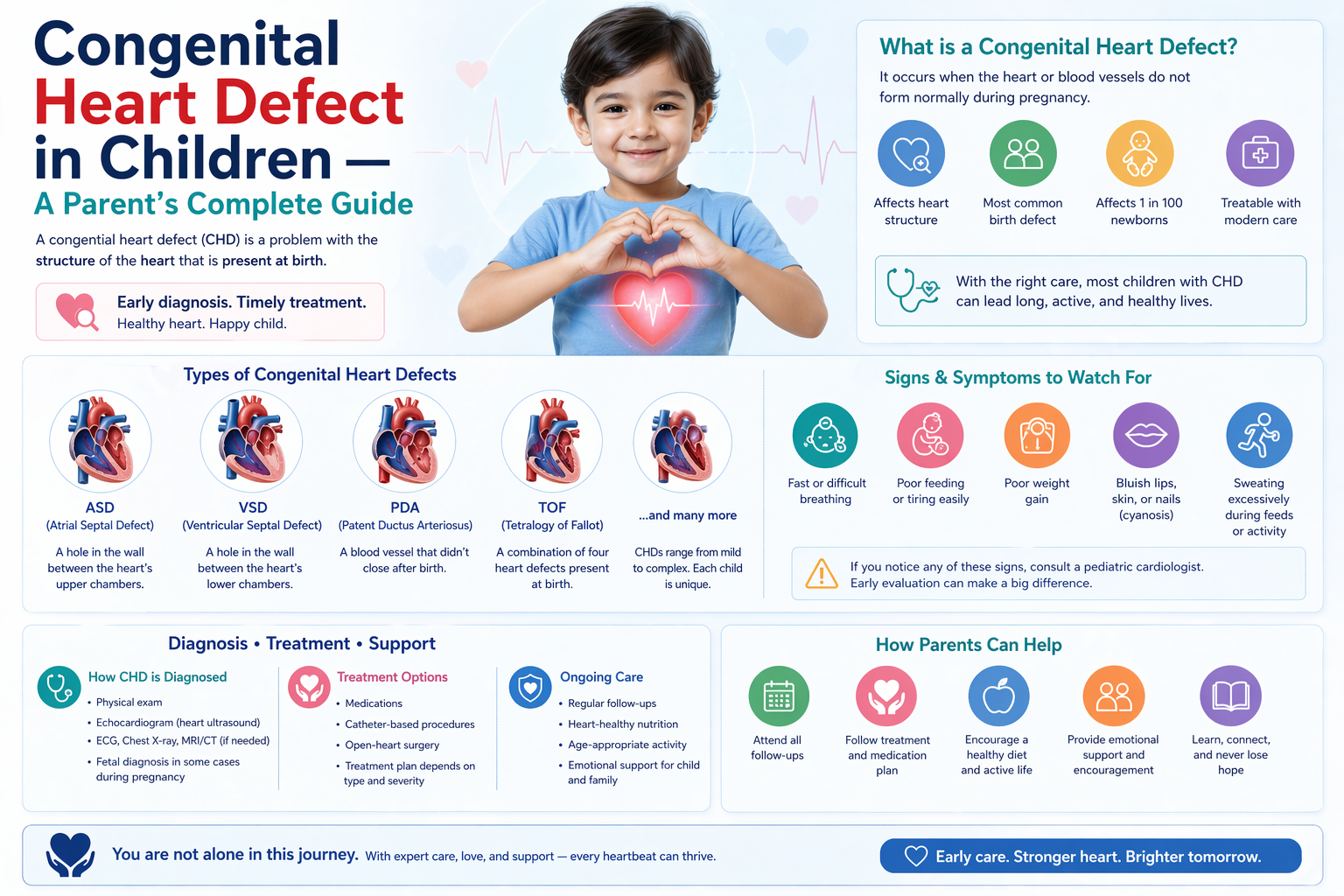
A congenital heart defect in children is a structural problem with the heart that is present from birth — and it is more common than most parents realise. Approximately 9 in every 1,000 babies born in India are affected. If your child has just been diagnosed, the most important thing to understand first is this: the majority of congenital heart defects can be completely corrected with surgery.
Dr. Ved Prakash, Director of CTVS at Yatharth Super Speciality Hospitals, Greater Noida, has been performing paediatric heart surgery since 2017 — operating on newborns, infants, and children with a wide range of congenital conditions. This guide is written for parents — to give you clear, honest answers in the most stressful weeks of your family’s life.
What Is a Congenital Heart Defect?
A congenital heart defect is any abnormality in the heart’s structure that develops during pregnancy. The heart forms in the first 8 weeks of fetal development — and during this complex process, variations can occur in the walls between chambers, the heart valves, or the major blood vessels leaving the heart.
Some defects are simple — a small hole between chambers that may close on its own. Others are complex — involving multiple structural abnormalities that require surgical correction in the first days or weeks of life.
What Causes a Congenital Heart Defect?
In most cases, no single identifiable cause is found. Known risk factors include:
- Chromosomal conditions such as Down’s syndrome (trisomy 21) — associated with ASD, VSD, and AV canal defects
- Rubella (German measles) infection in the mother during the first trimester
- Maternal diabetes — poorly controlled blood sugar during pregnancy increases risk
- Certain medications taken during pregnancy
- A family history of congenital heart disease — though most cases occur without family history
Parents should not blame themselves. Congenital heart defects are not caused by anything the mother ate, did, or felt during pregnancy in the vast majority of cases.
The Most Common Congenital Heart Defects in Children
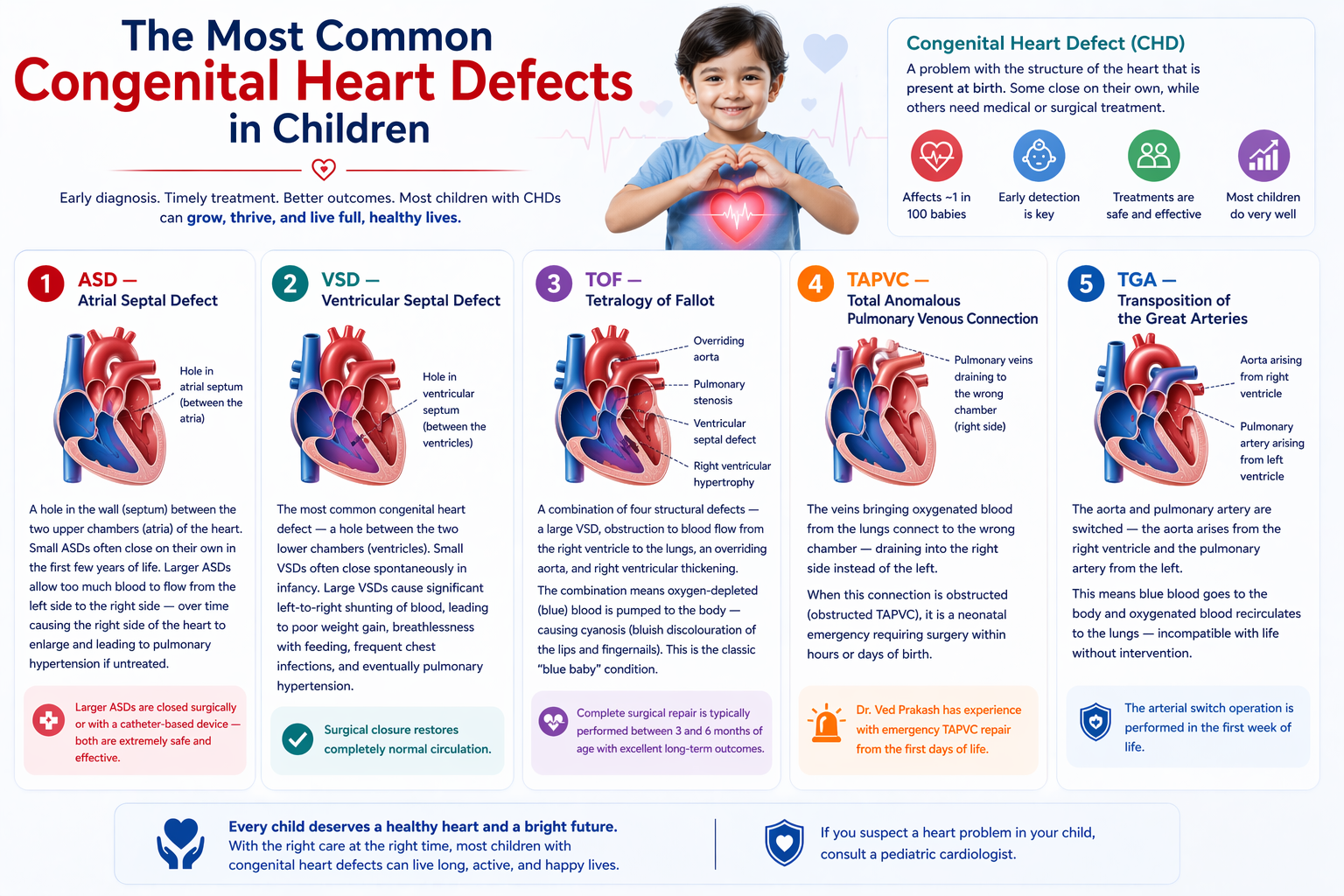
ASD — Atrial Septal Defect
A hole in the wall (septum) between the two upper chambers (atria) of the heart. Small ASDs often close on their own in the first few years of life. Larger ASDs allow too much blood to flow from the left side to the right side — over time causing the right side of the heart to enlarge and leading to pulmonary hypertension if untreated. Larger ASDs are closed surgically or with a catheter-based device — both are extremely safe and effective.
VSD — Ventricular Septal Defect
The most common congenital heart defect — a hole between the two lower chambers (ventricles). Small VSDs often close spontaneously in infancy. Large VSDs cause significant left-to-right shunting of blood, leading to poor weight gain, breathlessness with feeding, frequent chest infections, and eventually pulmonary hypertension. Surgical closure restores completely normal circulation.
TOF — Tetralogy of Fallot
A combination of four structural defects — a large VSD, obstruction to blood flow from the right ventricle to the lungs, an overriding aorta, and right ventricular thickening. The combination means oxygen-depleted (blue) blood is pumped to the body — causing cyanosis (bluish discolouration of the lips and fingernails). This is the classic “blue baby” condition. Complete surgical repair is typically performed between 3 and 6 months of age with excellent long-term outcomes.
TAPVC — Total Anomalous Pulmonary Venous Connection
The veins bringing oxygenated blood from the lungs connect to the wrong chamber — draining into the right side instead of the left. When this connection is obstructed (obstructed TAPVC), it is a neonatal emergency requiring surgery within hours or days of birth. Dr. Ved Prakash has experience with emergency TAPVC repair from the first days of life.
TGA — Transposition of the Great Arteries
The aorta and pulmonary artery are switched — the aorta arises from the right ventricle and the pulmonary artery from the left. This means blue blood goes to the body and oxygenated blood recirculates to the lungs — incompatible with life without intervention. The arterial switch operation is performed in the first week of life.
Warning Signs of a Heart Defect in a Child
- Cyanosis — bluish or purplish discolouration of the lips, tongue, or fingernails
- Feeding difficulties in infants — the baby tires quickly during feeds, takes a long time, or feeds poorly
- Poor weight gain — not growing as expected in the first months of life
- Sweating during feeds — excessive sweating while feeding is a classic sign of heart strain in infants
- Recurrent chest infections — frequent bronchiolitis or pneumonia in infancy
- Heart murmur detected on examination at birth or well-baby checks
- Exercise intolerance in older children — tiring much faster than peers, stopping to rest, breathlessness on mild activity
How Is a Congenital Heart Defect Diagnosed?
- Foetal echocardiogram: Many defects are now detected before birth during routine anomaly scans at 18–20 weeks. This allows planned delivery at a centre with paediatric cardiac surgical capability.
- Neonatal echocardiogram: Performed immediately after birth when a murmur is heard or cyanosis is noted
- Pulse oximetry screening: Oxygen saturation checked in every newborn — a simple, painless test that detects many serious defects
- CT angiography: For complex anatomy where echocardiogram alone is insufficient for surgical planning
- Cardiac catheterisation: For precise pressure measurements in cases with suspected pulmonary hypertension
What Does Treatment Involve?
Treatment depends entirely on the type and severity of the defect. Options include:
- Watchful waiting: For small ASDs and VSDs likely to close spontaneously — monitored with regular echocardiograms
- Catheter-based device closure: For suitable ASDs and VSDs — a device is delivered through a vein in the leg to plug the hole without surgery
- Open-heart surgery: For defects requiring direct repair under cardiopulmonary bypass — VSD closure, TOF repair, TAPVC repair, arterial switch
- Palliative surgery: For the most complex defects where complete repair is not possible in one operation — a staged approach over the first years of life
Frequently Asked Questions — Congenital Heart Defect in Children
My baby has been diagnosed with a congenital heart defect — what should I do first?
Request an urgent paediatric cardiology review and detailed echocardiogram if not already done. Then consult a paediatric cardiac surgeon. Do not delay for complex or cyanotic defects — some require intervention within days. For simpler defects (small ASD, small VSD), there is usually time to gather information and ask questions. You can also arrange an online cardiac consultation in India with Dr. Ved Prakash by sharing the echo report via WhatsApp.
Will my child need surgery immediately?
It depends on the defect. TGA and obstructed TAPVC require surgery within days of birth. TOF is typically repaired between 3 and 6 months. ASD and VSD surgery can often be planned as a semi-elective procedure within the first 1–2 years of life if the child is growing adequately.
What is the success rate for paediatric heart surgery in Delhi NCR?
For common defects such as ASD and VSD closure, success rates exceed 99% at experienced centres. TOF repair carries higher but well-managed risk — specific figures are discussed openly with every family before surgery.
Will my child live a normal life after heart surgery?
The great majority of children who undergo successful congenital heart surgery live full, unrestricted, normal lives. Annual cardiac follow-up with echocardiogram is typically recommended throughout childhood, but most children have no limitation on sport, activity, or daily life.
Can congenital heart defects be prevented?
Most cannot be prevented. Controlling maternal diabetes, avoiding alcohol and certain medications during pregnancy, and ensuring rubella vaccination before pregnancy reduce risk. But in the majority of cases, congenital heart defects occur without any identifiable cause or preventable factor.
Your Child’s Heart Is in Good Hands
If your child has been diagnosed with a congenital heart defect — or if you want a second opinion on a recommendation already given — consult Dr. Ved Prakash for paediatric heart surgery in Delhi NCR at Yatharth Super Speciality Hospitals, Greater Noida. Online consultation is available — share echo reports via WhatsApp for an initial assessment from anywhere in India.
Dr. Ved Prakash | Director CTVS — Yatharth Super Speciality Hospitals, Greater Noida
📞 +91-9355255106 |
Book Appointment →