
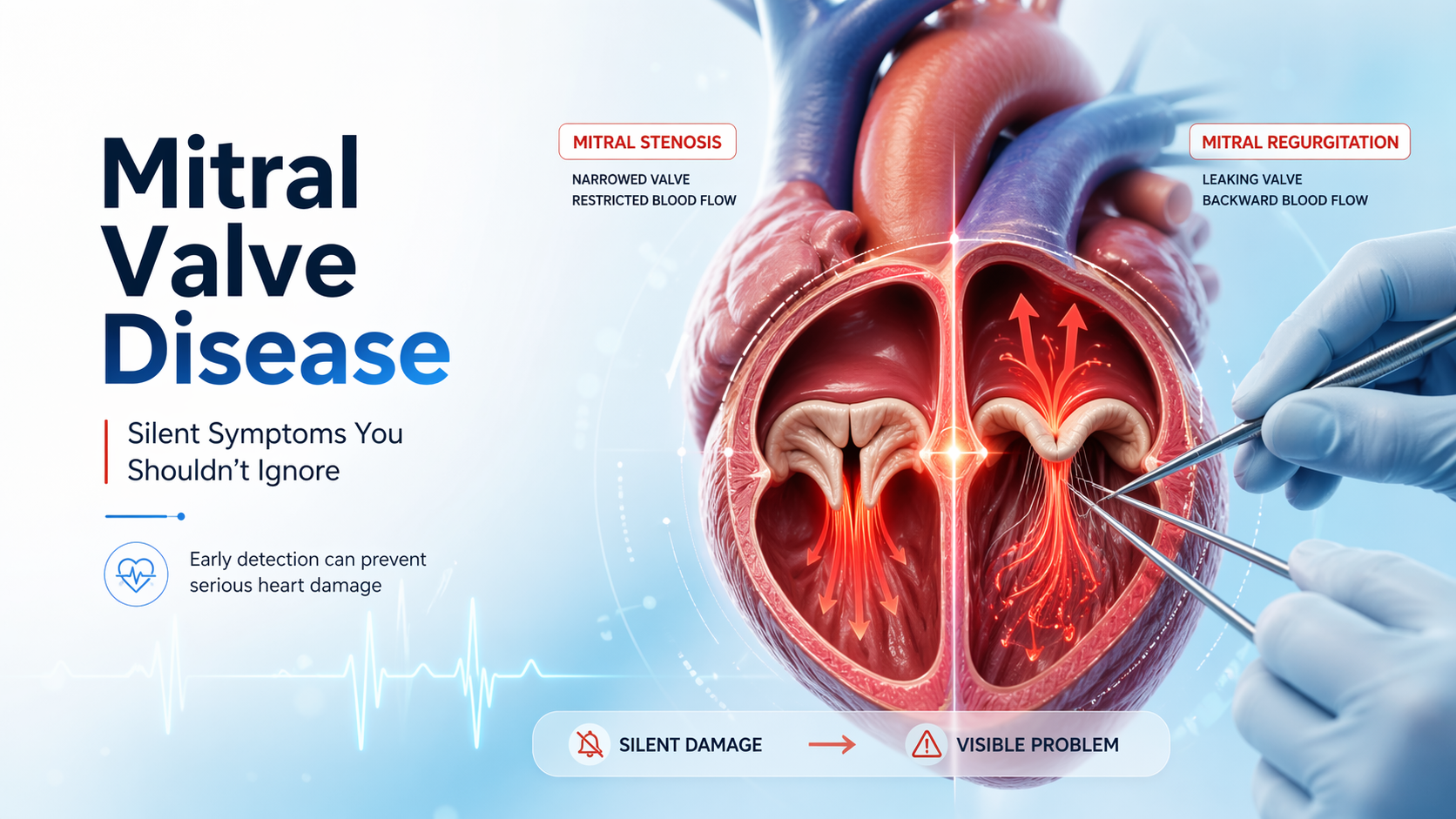
Mitral valve disease symptoms can be silent for years — and when they do appear, they are often mistaken for fitness issues, age, or general tiredness. By the time breathlessness or palpitations become significant, the heart muscle may already have been strained for a prolonged period.
Dr. Ved Prakash, Director of CTVS at Yatharth Super Speciality Hospitals, Greater Noida, explains what the mitral valve does, how it becomes diseased, and what the symptoms mean — so you can act before the condition becomes harder to treat.
What Is the Mitral Valve and What Does It Do?
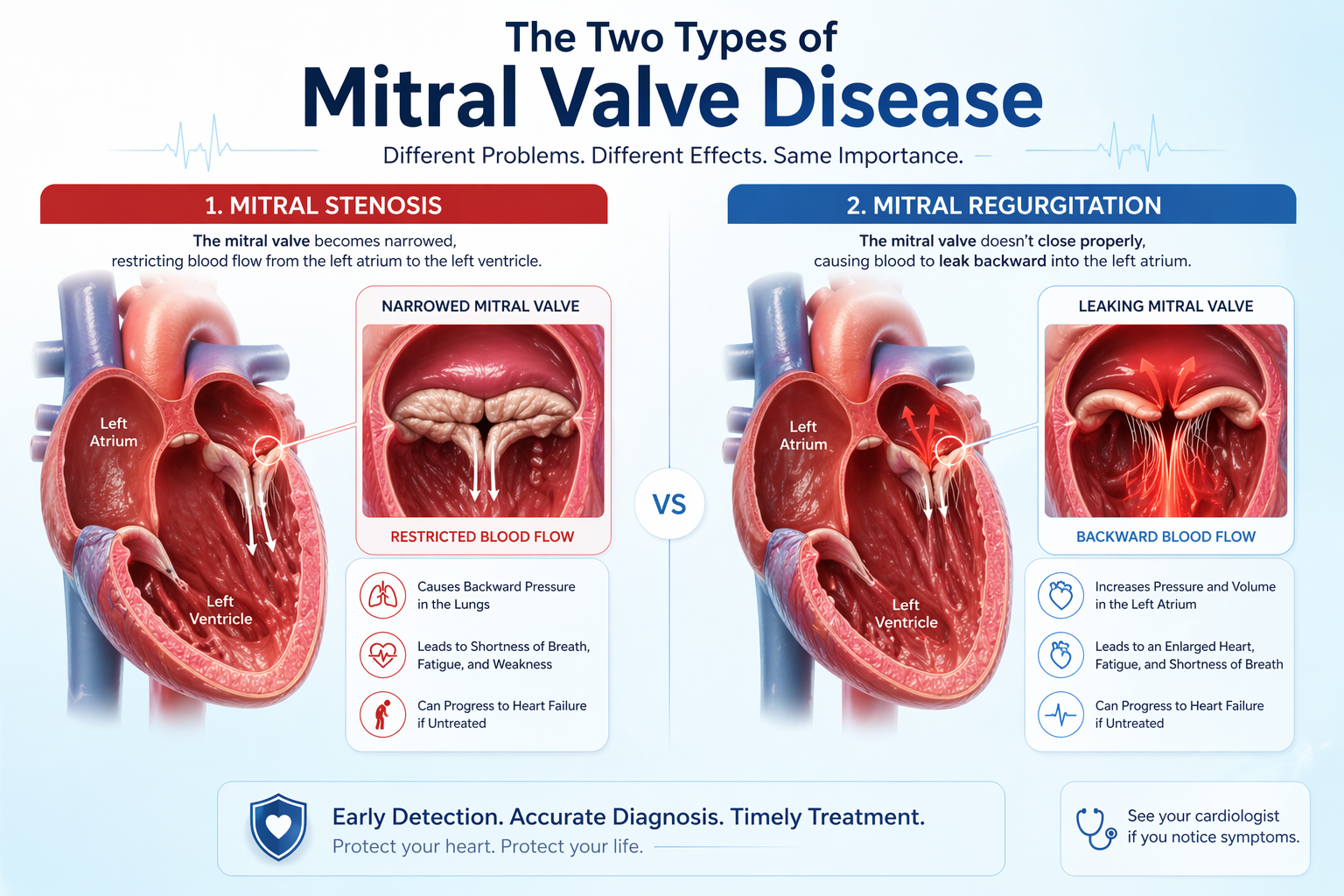
The mitral valve sits between the left atrium and left ventricle — the two chambers on the left side of the heart that receive oxygenated blood from the lungs and pump it to the body. Its job is to open fully when blood flows from the atrium into the ventricle, then close completely to prevent blood flowing backwards when the ventricle pumps.
When the mitral valve does not open fully (mitral stenosis) or does not close properly (mitral regurgitation), it disrupts the heart’s pumping efficiency — and over time, places serious strain on the heart and lungs.
The Two Types of Mitral Valve Disease
Mitral Stenosis — The Narrowed Valve
Mitral stenosis is a narrowing of the mitral valve opening, most commonly caused by rheumatic fever in childhood — a complication of untreated streptococcal throat infection. Rheumatic heart disease remains a significant problem across India, particularly in patients now aged 30–60 who had rheumatic fever as children without adequate treatment.
As the valve opening narrows, blood backs up into the lungs — causing breathlessness, exercise intolerance, and eventually atrial fibrillation (irregular heartbeat).
Mitral Regurgitation — The Leaking Valve
Mitral regurgitation occurs when the valve leaflets do not close completely and blood leaks backwards into the left atrium with each heartbeat. Causes include mitral valve prolapse (the leaflets bow backwards), degenerative valve disease (wear over time), and rheumatic heart disease affecting the valve leaflets.
The leaking means the heart pumps the same blood twice — forward to the body and backwards into the lungs — causing progressive heart muscle strain.
Mitral Valve Disease Symptoms — What to Watch For
- Breathlessness on exertion — particularly when climbing stairs, walking uphill, or carrying weight. Often the first and most common symptom.
- Breathlessness lying flat — many patients with mitral disease sleep with extra pillows because lying flat causes fluid to shift to the lungs (orthopnoea).
- Waking at night short of breath — called paroxysmal nocturnal dyspnoea. The patient wakes gasping or coughing and must sit upright to breathe comfortably.
- Palpitations — a racing, irregular, or fluttering heartbeat. Mitral stenosis is a major cause of atrial fibrillation, which significantly worsens symptoms and increases stroke risk.
- Fatigue and reduced exercise capacity — the heart cannot increase its output normally during activity because the diseased valve restricts flow.
- Swelling of ankles and feet — as the condition advances and right-sided heart pressure increases.
- Cough — sometimes with blood-tinged sputum — in severe mitral stenosis, elevated lung pressure can cause bleeding into the airways.
How Is Mitral Valve Disease Diagnosed?
- Stethoscope examination: A characteristic murmur is heard — a trained cardiologist or surgeon can identify mitral valve disease from the sound alone
- Echocardiogram (Echo): The primary investigation — shows the valve structure, opening area, degree of leaking, and the impact on heart chambers
- ECG: May show atrial fibrillation or signs of left atrial enlargement
- Chest X-ray: May show an enlarged heart or fluid in the lungs
- Cardiac catheterisation: Occasionally needed to assess coronary arteries before surgery in older patients
When Does Mitral Valve Disease Need Surgery?
Surgery is recommended when:
- Symptoms (breathlessness, palpitations, reduced exercise capacity) are present and moderate-to-severe
- The echocardiogram shows the heart chambers are enlarging — even before symptoms appear
- Atrial fibrillation develops as a result of the valve disease
- The ejection fraction begins to fall — indicating the heart muscle is under strain
Waiting too long is the most common mistake. Surgery performed before the left ventricle is significantly enlarged delivers far better long-term results than surgery performed after the heart has been damaged by years of volume overload.
Mitral Valve Treatment Options
- Mitral valve repair: The preferred operation for mitral regurgitation in suitable cases. The patient’s own valve is reconstructed — no prosthetic implanted, no lifelong blood thinners required. Dr. Ved Prakash attempts repair in every anatomically suitable case.
- Mitral valve replacement: For valves that are too damaged to repair — most commonly severely calcified rheumatic valves. A mechanical or biological prosthetic valve is implanted.
- Balloon mitral valvotomy: A catheter-based procedure for suitable cases of mitral stenosis — a balloon is used to widen the narrowed valve without surgery. Only applicable when the valve leaflets are pliable and not heavily calcified.
Frequently Asked Questions — Mitral Valve Disease Symptoms
What are the early symptoms of mitral valve disease?
The earliest symptom is usually breathlessness that is mildly worse than expected for your age and fitness level — particularly on exertion. Many patients initially attribute this to being unfit or getting older. A routine echocardiogram prompted by a heart murmur is how many cases are first diagnosed.
Can mitral valve disease be treated without surgery?
Medications can control heart rate and manage fluid retention (diuretics) — relieving symptoms temporarily. They cannot repair a structurally diseased valve. Surgery or intervention is required for definitive treatment once the disease reaches a moderate-to-severe stage.
Is mitral valve disease caused by rheumatic fever common in India?
Yes — India carries one of the world’s highest burdens of rheumatic heart disease. Patients now aged 30–60 who had sore throats and joint pains as children (often treated inadequately) frequently present with significant mitral valve disease decades later.
Can mitral valve disease cause a stroke?
Yes — particularly when mitral stenosis leads to atrial fibrillation. The irregular heartbeat causes blood to pool in the left atrium and form clots, which can travel to the brain. Anticoagulation (blood thinners) is started as soon as atrial fibrillation is diagnosed in the context of mitral valve disease.
What is the difference between mitral stenosis and mitral regurgitation?
Mitral stenosis means the valve opening is narrowed — blood cannot flow easily from the lungs into the heart. Mitral regurgitation means the valve leaks — blood flows backwards into the lungs instead of forward to the body. Both cause breathlessness and heart strain but through different mechanisms. Both may be present simultaneously in rheumatic heart disease.
Book a Mitral Valve Assessment in Delhi NCR
If you have been told you have a heart murmur, or if breathlessness or palpitations have been getting gradually worse, consult Dr. Ved Prakash for heart valve surgery in Delhi NCR. Bring your echocardiogram report to the consultation — or share it via WhatsApp for an online pre-assessment.
For more on valve surgery types and recovery, read our guide on what is heart valve surgery.
Dr. Ved Prakash | Director CTVS — Yatharth Super Speciality Hospitals, Greater Noida
📞 +91-9355255106 |
Book Appointment →